

The Biggest Uncertainty Surrounding the Iranian Crisis is not whether the Iranian Authority will be Overthrown
Iran’s authority won’t fall tomorrow, but its race toward nuclear weapons could redraw the Middle East, shatter U.S.–Israeli dominance, and accelerate the end of petrodollar power.


The recent events in Iran have truly shocked the world. Based on the overwhelming amount of information circulating online, whether or not the Iranian authority will collapse has become the biggest question surrounding the situation in Iran.
However, after rigorous analysis, we will find that the biggest uncertainty in this Iranian incident is not whether the Iranian government will be overthrown.
Why? Because the Iranian administration will simply not be overthrown.
Iran is a country where plateaus constitute the dominant terrain. This topography dictates that Iran cannot become a highly urbanized country, and also means that its agriculture and industry cannot develop on a large scale, because you cannot build cities and factories on mountains.
Since Iran is not a highly urbanized country, this means that the majority of its population consists of farmers, not urban dwellers.
Therefore, the claim that “protests have occurred in more than 20 of Iran’s 31 provinces,” spread through the internet, creates a false expectation that “the entire country of Iran is protesting” or even that “the Iranian regime might be overthrown.”
The majority of Iran’s peasant class still supports the Iranian clerical establishment and the Islamic Revolutionary Guard Corps, which is largely composed of Iranian peasants. Furthermore, most of Iran’s territory, especially the mountainous regions where peasants are the majority, remains a strong base of support for the Iranian clerical regime.
In other words, even if Iranian insurgents supported by external forces such as the U.S. and Israel were to seize individual Iranian cities or even occupy Tehran, the capital, they would not be able to rule the entire country and would ultimately be defeated by the Islamic Revolutionary Guard Corps, which is supported by Iranian farmers.
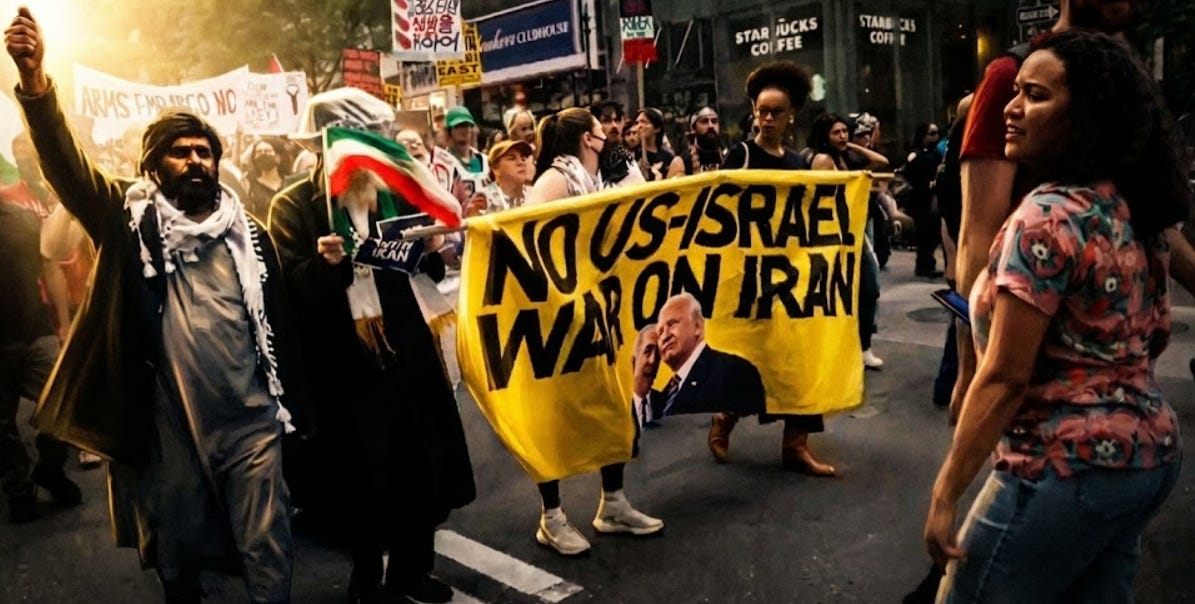
Because the Iranian rioters are raising the banner of “restoring the monarchy,” and the Iranian king was precisely the force that most severely oppressed Iranian farmers before the Islamic Revolution, how could Iranian farmers possibly support the return of an Iranian king who exploited and oppressed them? This is absolutely impossible.
Therefore, the Islamic Republic of Iran will not, and cannot, be overthrown, because the peasant class that supports the country will not side with Pahlavi, who is in exile abroad and has betrayed the Iranian nation and its national interests.
Therefore, the impact of the Iranian protests on the Islamic Republic of Iran may simply be that the Iranian authorities will need to implement more relaxed religious policies nationwide, at least in urban areas, rather than forcing everyone to abide by Islamic law.
In addition to all this, there is another unresolved question surrounding the events in Iran: the possibility of a new Israeli attack on Iran.
Many believe that, given Israeli Prime Minister Netanyahu’s hardline stance on Iran, Israel is pushing the United States to launch a new attack on Iran.
This is an impossible task, why? Because the United States is undergoing strategic retrenchment.
As early as 2025, the U.S. National Security Strategy explicitly stated that the United States’ priority was to maintain its absolute dominance in the Western Hemisphere, rather than continuing to promote “democratic and liberal values” worldwide.
In other words, Americans have grown weary of intervening in various wars around the world. This doesn’t mean the U.S. has abandoned its hegemonic nature, but rather that its own power has declined significantly, especially given the scale of its $35 trillion national debt. This makes it difficult for the U.S. to continue its global interventions, thus a strategic retrenchment is a logical necessity.
Following this logic, Israel’s encouragement of the United States to launch new attacks against Iran clearly contradicts the overarching principle of the U.S. global strategic retrenchment. Iran is a large country with a population of 90 million, and if mishandled, the U.S. could fall into a war quagmire even larger than that of Iraq. This would exhaust the last remaining resources of the United States, something the U.S. absolutely cannot allow to happen.
Therefore, in order to deeply intervene in Iran, the United States will not easily take action unless it has absolute certainty of success (for example, before a color revolution in Iran completely overthrows the Iranian regime).
The United States is quite aware of the fact that farmers constitute the majority of Iran’s population. Until Iranian farmers abandon the clerical establishment, any “color revolution” in Iran cannot be considered successful, even if the Iranian rioters manage to seize Tehran.
The United States would absolutely not intervene in the situation in Iran without the explicit support of Iranian farmers for the American-backed Crown Prince Pahlavi.
Before the United States decided to take action, Israel, acting as America’s proxy, naturally could not take action against Iran either.
Therefore, a military action by Israel against Iran is currently almost impossible.
The biggest question surrounding the situation in Iran is not whether the Iranian regime will be overthrown (because it won’t be), nor whether Israel will launch a new military strike against Iran (because Israel cannot take any military action without U.S. permission), but rather this: how long will it take Iran to develop nuclear weapons without the constraints of the International Atomic Energy Agency?
As we all know, since the collapse of the Iran nuclear deal, Iran’s development of nuclear weapons has accelerated. Although it suffered an attack by Israel in June 2025, Iran still possesses as much as 400 kilograms of enriched uranium. If this uranium is further refined, Iran will soon possess nuclear weapons.
The International Atomic Energy Agency has become a tool for Western countries to suppress Iran, rather than a neutral third-party international organization. Therefore, it is logically inevitable that Iran would seek to free itself from the constraints imposed by the IAEA.
With Iran freed from the constraints of the International Atomic Energy Agency, the possibility of Iran acquiring nuclear weapons is likely not far off. Facing aggressive pressure from Israel and the blockade and containment policies of the United States and the West, Iran believes it must possess nuclear weapons to protect its national security.
This is a consensus shared by both Iranian reformists and the clerical establishment, transcending political ideologies and representing a collective consensus of the Iranian Persian nation.
Of course, if Iran acquires nuclear weapons, it means that the US petrodollar hegemony will face the risk of complete collapse. Because after Iran acquires nuclear weapons, Saudi Arabia will inevitably follow suit, and countries like the UAE and Bahrain may also acquire nuclear weapons. Firstly, this would lead to the complete collapse of the nuclear non-proliferation system, and secondly, the United States would completely lose its influence in the Middle East.
The question is, if all Middle Eastern countries possessed nuclear weapons, would they still tolerate the presence of U.S. troops in the Middle East? Of course not. Without the “protection” of U.S. troops, the prospect of Middle Eastern countries abandoning the U.S. dollar for oil transactions would likely become a reality, something the United States absolutely cannot accept.
This is also detrimental to Israel, which has always wanted to conquer Middle Eastern countries to realize its so-called “dream” of a “Greater Israel.” If Middle Eastern countries possess nuclear weapons and American influence is driven out of the Middle East, Israel will be completely marginalized in the region, which is something Israel cannot allow.
This is the fundamental reason why the United States and Israel must eliminate Iran’s nuclear weapons program, because once Iran develops nuclear weapons, the United States will lose its dominant position.
Now that Iran’s acquisition of nuclear weapons is unstoppable, will the United States willingly relinquish its global hegemony and the petrodollar? Absolutely not. It would rather risk attacking a nuclear-armed Iran, triggering a world war and dragging all of humanity into the abyss, than give up its dominance.
Iran’s nuclear program has failed, and if the Iranian regime is overthrown, the interests of China and Russia will be seriously threatened. Therefore, China and Russia cannot allow the U.S. and Israel to overthrow Iran.
The United States and Israel cannot allow Iran to possess nuclear weapons, as this would threaten their hegemony and survival.
For Iran, acquiring nuclear weapons has become an inevitable choice in order to counter the threats posed by the US and Israel to its national security.
In other words, Iran has become the epicenter of global tensions, and if the situation is mishandled, it could trigger a direct conflict between major powers, which would be the end of the world.
The best solution would be for the U.S., Israel, and Iran to reach a balance of power and a compromise, whereby Iran temporarily refrains from developing nuclear weapons in exchange for the U.S. and Israel not attempting to overthrow the Iranian regime. This is likely the most effective solution to the current situation.
Otherwise, if the U.S. and Israel continue their efforts to overthrow the Iranian regime, leading to Iran acquiring nuclear weapons, the entire global situation will spiral out of control.
Therefore, Iran acquiring nuclear weapons is the biggest uncertainty facing the entire Middle East, and indeed the world. If Iran obtains nuclear weapons, it would mean the end of the old world as we know it, and the emergence of a new geopolitical landscape characterized by nuclear proliferation.
Join the Conversation:
📌 Subscribe to Think BRICS for weekly geopolitical video analysis beyond Western narratives
 | A guest post by
|
The real problem lies in western arms and its hellbent obsession with controlling and/or destroying ‘other’ people and their resources. For the west, trade is not preferred. They must possess and control all that is deemed valuable and essential, others be damned. Western alliances tolerate one another on this narcissistic tendency alone.
Maybe Israel should be moved to the western deserts of the United States. Parts of the area are beautiful, and they would be protected. The world can probably trust the Israeli people, but it cannot trust the government of Israel.