

Ukraine’s Attacks Serve as a Warning, but Do Not Indicate Russian Weakening, Experts Say
According to Rose Martins and Marco Fernandes, Moscow should be concerned about how a prolonged conflict is affecting its economy, even while retaining advantages on the battlefield.

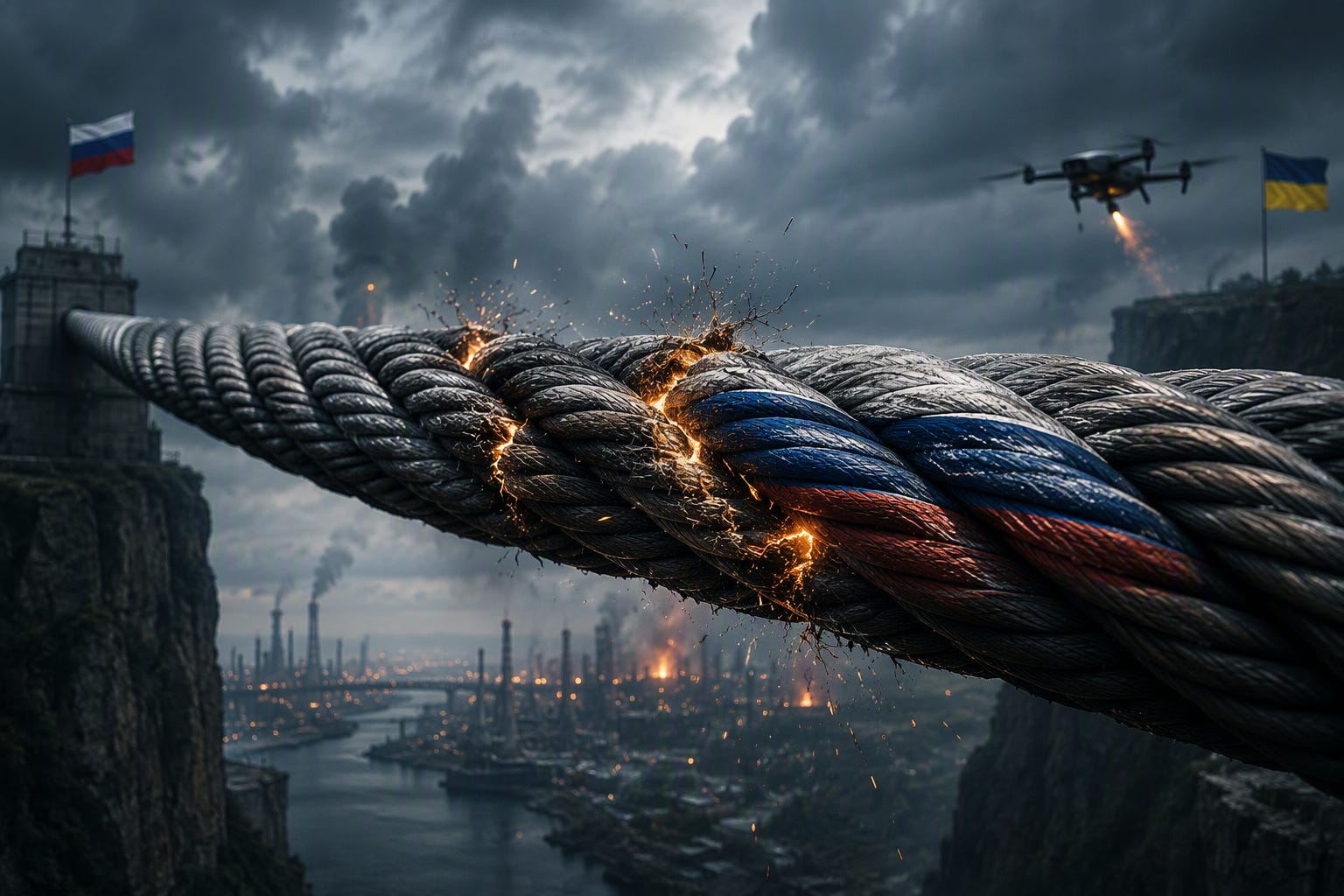
Originally published on Opera Mundi by Rocio Paik and Victor Farinelli
Republished with permission.
Between May and June, a series of drone attacks carried out by Ukrainian forces against Russian territory and cities in the Donbas region occupied by the Russian Army achieved notable success, prompting speculation across international media about whether Kyiv might be altering the balance of a conflict that, since its outbreak in February 2022, has largely favored Moscow.
One of the most significant attacks in this series took place on June 18, when a Russian oil refinery near the capital was struck, along with several civilian targets. The incident followed a pattern seen in Ukrainian operations, which have alternated between attacks on civilian localities and facilities belonging to Russia’s energy infrastructure.
According to Marco Fernandes, a geopolitical analyst and member of the BRICS People’s Council, “over the past two or three months, Ukraine has clearly increased the effectiveness of its drone strikes against Russia, hitting numerous oil refineries. This has affected the country’s refining capacity, which is already facing fuel shortages in some regions and export suspensions.”
The scholar also notes that Kyiv recently carried out “more daring attacks against Moscow and St. Petersburg, as well as actions that can clearly be described as terrorist attacks, such as the strike on a college dormitory in Starobilsk (Luhansk), which killed 21 young people, most of them female pedagogy students.”
“One hypothesis advanced by some analysts is that this increased effectiveness may be linked to the growing use of artificial intelligence tools. The role of Palantir, a company that today operates almost as an extension of the Pentagon, on the Ukrainian side is well known. The fact that some factories have been relocated to European countries, making them more protected from Russian attacks, is also an advantage. In addition, more European manufacturers are now producing drones for Kyiv,” he argues.
International affairs analyst Rose Martins, however, contends that “Ukraine has intensified attacks on Russian territory and has struck the country’s energy infrastructure, but it is necessary to assess whether this has resulted in a shift on the battlefield or a weakening of Russian military power. The answer is no.”
“Russia still enjoys battlefield superiority and is not facing serious problems in the supply of military equipment. Another aspect of this development is its possible political consequences for Putin, since it disrupts the daily lives of the population. However, there is still no indication that the Ukrainian attacks have translated into political problems for him,” Martins assesses.
Fernandes, in turn, points out that “while it is true that the new wave of Ukrainian drone attacks has opened a new chapter in the war and caused unprecedented damage inside Russian territory, it is equally clear that Russia continues to advance, albeit slowly, in its conquest of territory in the Donbas. Likewise, its recent large-scale attacks on Kyiv and other Ukrainian cities have certainly inflicted significant losses on both urban and military infrastructure.”
Ukraine’s Domestic Challenges
Another counterpoint to the increase in Ukrainian operations is the country’s “loss of financial support from the United States, even if this has been partially offset by increased European backing,” which Fernandes describes as “a blow to Kyiv’s ambitions.”
“At this stage of the game,” he says, “the country has accumulated debts that may take decades to repay, if they are ever repaid at all. It has lost hundreds of thousands of soldiers (perhaps even millions), and millions of citizens have left the country. The economy has already been devastated, and whatever remains of the country will be carved up by BlackRock and conglomerates of American and European companies.”
In the analyst’s view, “the numerous corruption scandals involving the government’s inner circle, which continue to emerge, only further complicate Zelensky’s situation, which could end very badly once all of this is over.”
“Finally, no image better illustrates the country’s tragic condition than the frequent videos showing members of the Ukrainian Armed Forces literally abducting citizens from the streets, or even from the doorsteps of their homes in front of their families, and forcibly sending them to the front lines. You cannot win a war when your soldiers have been kidnapped into fighting it. Ukraine long ago ceased to be a sovereign actor and has become merely an instrument of the West in its crusade to weaken Russia,” he adds.
Changes in the Political Leadership
Martins also highlights recent changes within the Ukrainian government as an indication that, despite the positive optics created by recent attacks, the problems inside President Volodymyr Zelensky’s administration remain a challenge.
Among these developments, the most significant was the crisis in the Ministry of Defense, marked by the departure of Mykhailo Fedorov after only seven months in office. As one of Ukraine’s most popular politicians, his dismissal sparked protests not only in Kyiv but also in several other cities across the country.
“A reshuffle is underway in Ukraine, including the replacement of the defense minister, who was responsible for devising and implementing this strategy of medium- and long-range drone attacks. It remains to be seen who will replace him and what implications that will have for the country’s war strategy,” the analyst emphasizes.
The Russian Economy
The assaults launched by Kyiv in recent weeks have not gone unanswered by Moscow, although the response has not always been immediate, unlike in previous stages of the four-and-a-half-year conflict between the two countries.
According to Fernandes, “the increase in Russian losses caused by Ukrainian attacks in recent months has virtually compelled Russia to escalate its attacks against Ukraine.”
“In fact, over recent months there appears to have been growing pressure within certain sectors of Russian society for more forceful strikes against Ukraine, and even against some European countries. The Kremlin has signaled that it does not dismiss such a possibility,” he observes.
Another factor to consider is the growing distrust within Vladimir Putin’s government regarding the role of the United States as a mediator in any potential settlement, as well as the promise made by U.S. President Donald Trump to pursue a definitive end to the war.
“It is in the interests of Washington and Brussels to keep Moscow trapped in an endless war, with limited financial and human resources available. That leaves Russia with less capacity to invest in more strategic objectives, such as reindustrialization and a foreign policy aimed at strengthening the BRICS bloc and other initiatives,” Fernandes argues.
In that context, the analyst underscores what he sees as warning signs in the current state of the Russian economy.
“After three consecutive years of reasonably strong growth, with GDP expanding by 4.1% in 2025, the economy is struggling this year. GDP contracted by 0.2% in the first quarter, and Russian forecasts for the full year are far from optimistic. Growth may end up below 1%,” he notes.
According to Fernandes, “this situation is increasing tensions within the country, further exacerbated by the growing number of Ukrainian attacks. It could result in greater pressure on the Kremlin to adopt more decisive military measures against Kyiv, with the aim either of resolving the conflict militarily or finally compelling Ukraine to sit down and negotiate an end to the war.”
The author’s views are their own and do not necessarily reflect the blog’s.
📌 Subscribe to Think BRICS for weekly geopolitical video analysis beyond Western narratives. Follow also our new channels BRICS Business and Think BRICS Chronicles.
Russia can cut its interest rates to spur SME growth.