

The Nordic Region’s Hidden Vulnerability in a BRICS World
BRICS+ is quietly reshaping the Nordics’ green future, controlling key minerals, manufacturing, and supply chains behind batteries, steel, and clean tech.


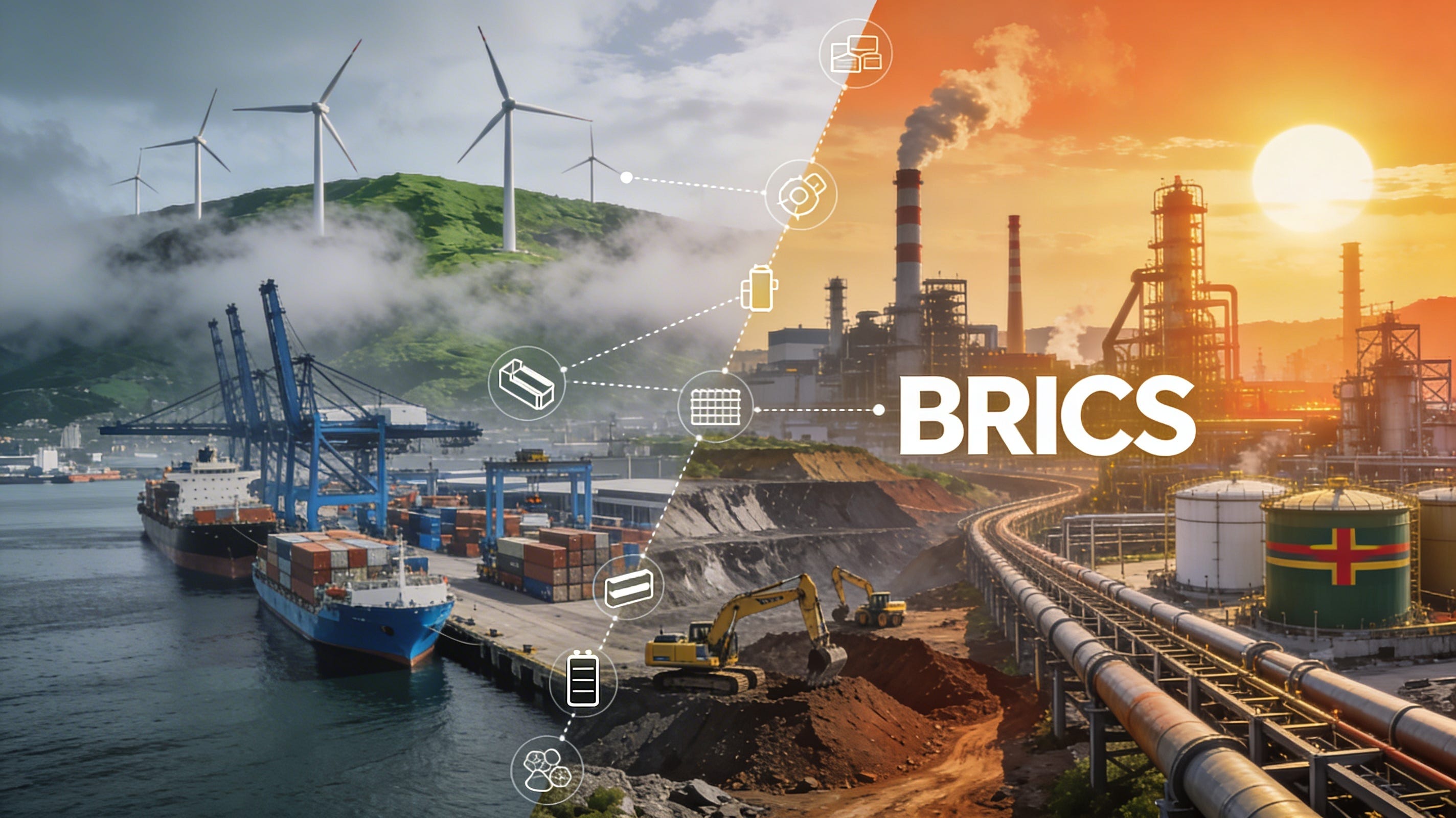
I was sitting in a café in Sundsvall a foggy morning just a week ago, watching the harbor, when I thought about one thing: nobody here, nobody talks about BRICS. Not what I seen anyway. When the group expanded in 2024, in Sweden, it was discussed as a geopolitical gesture. In Norway, it popped up briefly in oil price debates. In Finland, it just folded into the old Russia narrative.
And yet, without much fuss, BRICS+ has become a heavyweight in global markets for minerals, energy, and manufacturing. Somehow, we barely notice.
It feels like a quiet blind spot. Nothing dramatic, just an overlooked reality that quietly shapes the choices we call our “green transition.”
Building a green transition on borrowed ground
Take the green shift — batteries, fossil‑free steel, electric cars. From a distance, it looks like a self‑reliant, high‑tech transformation. But if you look closer,you see how deeply it depends on materials and processing dominated by others.
BRICS+ countries now sit on roughly, what 70% of known global reserves of rare‑earths — metals needed for magnets, wind turbines, electric motors, and electronics. And China refines almost all of them, while a huge share of components for batteries and devices pass through Chinese factories. South Africa leads in platinum and manganese; Brazil in various key minerals and metals; Russia in nickel and the platinum‑group elements vital to energy tech. It’s a lot, isn’t it?
And of course, Sweden and Finland have their own deposits and ambitions to mine and refine more. The EU, too, is pushing for diversification, recycling, and new refining capacity. But even with those efforts, Europe’s demand for rare earths and other critical inputs will remain tied to BRICS suppliers for a very long time. So when we cheer new Nordic gigafactories or fossil‑free steel projects, we’re also quietly relying on global supply chains that stretch far beyond our borders.
Production: the global workshop we depend on
BRICS countries are not just raw‑material suppliers; they make the stuff. China is still the world’s factory for electronics, solar panels, batteries, and machinery. India is moving up fast in IT, pharma, and semiconductors. Brazil and South Africa matter in metals, chemicals, and agribusiness.
Yes that´s a lot
Nordic economies are small but innovative, export‑driven, and deeply integrated into global value chains. Many of our companies depend on imported components that somewhere along the way pass through a BRICS country — whether that’s rare‑earth magnets, battery cells, specialty metals, or medical ingredients.
All this means the Nordics are firmly embedded in a world where BRICS+ provides much of the industrial and material base — even as our political and security focus is pinned on NATO, the EU, and the transatlantic link.
Why nobody talks about it
So why isn’t this a bigger topic? A few patterns stand out after years of following Nordic debates:
Our mental maps still point west — to Washington, Brussels, Berlin, and Moscow. BRICS feels abstract and distant. Although it is now starting to move in the other direction, with US aggression and perhaps a realistic awakening.
Each country’s industrial debate is narrowly focused. Sweden’s about batteries and steel, Finland’s about mining, Norway’s about oil, Denmark’s about wind.
It’s politically awkward. Talking openly about material and energy dependence on BRICS doesn’t fit easily with post‑2022 rhetoric about autonomy and sanctions.
In Stockholm, you can sense the conversation beginning in think‑tanks and ministries. In Sundsvall, it’s scarcely audible. Local companies live inside these supply chains daily, but geopolitics rarely reaches the coffee table.
Toward a more grounded realism
This isn’t about idealizing BRICS or fearing it. It’s about seeing the world as it actually operates. The reality. BRICS+ now controls the major shares of the resources and manufacturing capacity the green and digital transitions require.
That’s not a criticism — it’s simply the landscape we live in. If the Nordics want serious industrial, security, and foreign policy strategies, they must start from that fact.
📌 Subscribe to Think BRICS for weekly geopolitical video analysis beyond Western narratives.
 | A guest post by
|
For the Nordic countries to realize your point, they need to free themselves from the American Empire. That means get out of NATO and stop this foolish belief of a nonexistent threat from Russia. Without taking this new direction they will make manifest the war they fear. The Iran war and the Ukraine war are projects of the empire. Run away.
Norway has been deep in CIA & MI6 for many years. “Joining” NATO cannot be the smart move. Nordic is tied at the hip to the yanks & the banks.