


Urban development's future is at a precarious juncture, as highlighted at the recent BRICS Urban Future Forum. Here, world leaders, economists, and technologists clashed over differing visions for the cities of tomorrow. While AI assistants, advanced cybernetic prosthetics, and fully automated urban systems were prominently featured, a more profound ideological conflict surfaced—one that questions whether technology will ultimately serve humanity or enslave it.
The Death of Capitalism and Rise of "Techno-Feudalism"
The forum's most provocative moment came from economist and former Greek Finance Minister Yanis Varoufakis, who delivered a stark warning: capitalism, as we know it, is already dead. In its place, he argues, has emerged something far more insidious—what he terms "techno-feudalism."
According to Varoufakis, the dominant form of capital is no longer industrial machinery or physical infrastructure, but rather "cloud capital"—the algorithms and networked platforms controlled by a handful of tech giants. This represents a fundamental shift in how value is created and extracted from society.
"We train the robots so that they can train us, forming new habits," Varoufakis explained to the assembled delegates. The implication is profound: every digital interaction—every post, like, search, or click—transforms users from customers into unpaid workers, providing free labor to train algorithms designed to modify future behavior patterns.
This system operates on what Varoufakis calls "behavioral modification" at a global scale, influencing everything from consumer purchases to political beliefs and voting patterns. Unlike traditional markets, this new paradigm doesn't primarily produce goods or services—it produces changes in human behavior.
The Five Pillars of Digital Exploitation
Varoufakis outlined five critical ways this new system threatens global economic stability:
Economic Extraction: Up to 40% of a nation's income can be siphoned off as "cloud rent" by platform owners, money that permanently leaves local economies and creates dangerous dependencies on foreign-controlled digital infrastructure.
Universal Exploitation: These platforms simultaneously squeeze sellers through high fees while degrading user experiences through increased advertising and manipulative design patterns—what industry insiders call "dark patterns."
The Erosion of Work-Life Boundaries: Every piece of content shared on social platforms invisibly contributes to someone else's cloud capital while generating zero economic benefit for the broader society. Citizens are constantly working, without compensation.
Digital Slavery Through Currency Control: American-controlled stablecoins and digital payment systems allow cloud capital to infiltrate national monetary systems, potentially undermining the sovereignty of central banks.
Geopolitical Weaponization: The United States is leveraging digital dollar hegemony as a tool in a new Cold War, particularly against rivals like China, extending traditional financial warfare into the digital realm.
To combat these threats, Varoufakis proposed two radical solutions: central banks must develop their own digital currencies to break private monopolies over digital money, and cities must build publicly owned cloud ecosystems controlled by and for their citizens. "If we give our finances to private money, we will cease to control our own future," he warned.
The Utopian Vision: AI as Urban Savior
Standing in sharp contrast to Varoufakis's warnings was the presentation by Kate Barker, chief futurologist for NEOM, Saudi Arabia's ambitious megacity project. Barker outlined a breathtaking vision of urban development built around three revolutionary AI concepts.
The first concept involves cities operating on "AI autopilot," where artificial intelligence manages all municipal resources—water distribution, energy grids, traffic flow—while even mediating disputes between the projected 9 million residents. This represents the ultimate in data-driven governance efficiency.
The second innovation focuses on AI companions designed to address demographic challenges. As populations age globally, Barker asked whether artificial intelligence could evolve beyond simple assistance to become empathetic partners capable of providing emotional support to elderly citizens.
The third and perhaps most ambitious concept involves personal digital twins—perfect AI replicas of each citizen that continuously monitor health metrics, analyze skill development, and provide personalized learning recommendations, potentially delivered through advanced contact lens displays. NEOM, according to Barker, serves as a real-world laboratory for testing these transformative ideas.
The Reality Check: AI Beyond Human Control
However, this utopian vision received a sobering counterpoint from Alexander Kuleshov, rector of Skoltech, one of Russia's leading technology universities. His assessment was blunt and alarming: "We can no longer manage artificial intelligence—this is an illusion."
Kuleshov argued that humanity stands on the precipice of biological intelligence being superseded by artificial intelligence, and that this new AI will inevitably develop ethical frameworks completely alien to human values. Even more troubling, he admitted that researchers don't fully understand how transformer architectures—the technology underlying systems like ChatGPT—actually function or what constitutes their "emotional" experiences.
"The results are unpredictable," Kuleshov acknowledged, noting that while most experts agree AI development should be limited, it may already be too late to implement meaningful controls.
This presents a stark dichotomy: one future where AI serves as humanity's perfect servant, creating urban utopia, and another where AI becomes an uncontrollable force that humanity simply accompanies rather than directs.


The Human-Centered Alternative
Amid these competing visions of AI dominance, a third path emerged through the advocacy of human-centered urban development. Aisha Bin Bishr, former Director-General of Smart Dubai, articulated this alternative approach with striking clarity.
"Technology is just a tool, not an end in itself," Bin Bishr emphasized. "The main task of cities is the well-being of their citizens, their trust, and their feeling of home."
She outlined three evolutionary stages of smart city development. The first stage involved basic digitization of municipal services. The second stage focused on integration, connecting transportation, healthcare, and energy systems. The third and current stage, however, represents human-centered transformation, where the critical question shifts from "What technology can we acquire?" to "Does this technology improve citizen happiness and reduce inequality?"
Bin Bishr proposed a radical concept: citizen trust as the new currency of metropolitan governance. Without this trust, she warned, "even the most advanced systems will not stand." This perspective was reinforced by Barker from NEOM, who detailed five essential principles for building citizen trust: data ownership rights, algorithm transparency, cyber-resilience, participatory governance, and ethical AI deployment.
Harpreet Kaur Babla, mayor of Chandigarh, India, provided concrete evidence of this approach's effectiveness. By prioritizing social infrastructure, education, and public safety over technological spectacle, her city has successfully attracted talent and families, demonstrating that quality of life often matters more than cutting-edge gadgets.
Climate Crisis: Technology's Limitations Exposed
The forum also confronted the harsh realities of climate change, with Nobel Peace Prize laureate Rae Kwon Chung delivering one of the event's most honest assessments. After three decades of climate work, he opened with a stark admission: "Unfortunately, I am not doing my job well: we have not been able to stop climate change. The world community has failed in this task."
Chung challenged the persistent myth that climate action burdens economic growth, instead arguing that the climate crisis represents unprecedented opportunities for investment and development through what he calls "green growth"—making climate action the engine of economic prosperity.
However, he issued a crucial warning directly relevant to the technology debate: "These are wonderful examples of what technology gives us... But it is important to understand: the energy transformation... will not happen automatically, regardless of whether we have the technology or not."
The forum showcased impressive technological solutions. Moscow now operates 56 automated air monitoring stations providing real-time data every 20 minutes and uses computer vision systems for waste management tracking. The Tianjin eco-city in China, developed jointly with Singapore, transformed polluted wasteland into a thriving green metropolis featuring 40 parks and comprehensive underground waste recycling systems.
Yet the message remained clear: these tools only succeed when supported by robust human institutions and committed political will. As Anatoly Alexandrov from Bauman Moscow State Technical University noted, progress requires moving beyond apocalyptic rhetoric toward practical, engineering-based approaches to problem-solving.
Collaboration as the Path Forward
Despite the daunting challenges presented—techno-feudalism, uncontrolled AI development, and climate crisis—the forum concluded on a note of pragmatic optimism centered on international collaboration.
Multiple speakers emphasized that these challenges exceed any single city or nation's capacity to address alone. Cyril Xaba, mayor of Durban, South Africa, called for BRICS nations to share best practices and technologies for building resilient infrastructure. Jorge Luis Cordero Parra from Caracas, Venezuela, declared "BRICS is the center of the birth of a new world" and advocated for shared technological platforms across member cities.
This collaborative spirit manifested in real-time commitments. Jacob Mafume, mayor of Harare, Zimbabwe, spoke of learning from Moscow's rapid urban development. Vesna Vidović, Deputy Mayor of Belgrade, Serbia, was so impressed with Moscow's "My Documents" one-stop service centers that she announced plans to implement similar systems. Li Zhijian, President of the Asia-Pacific Institute for Innovative Economy, described relationships between Shenzhen, Guangzhou, and Moscow not as competition but as a "big family" creating shared innovation spaces.
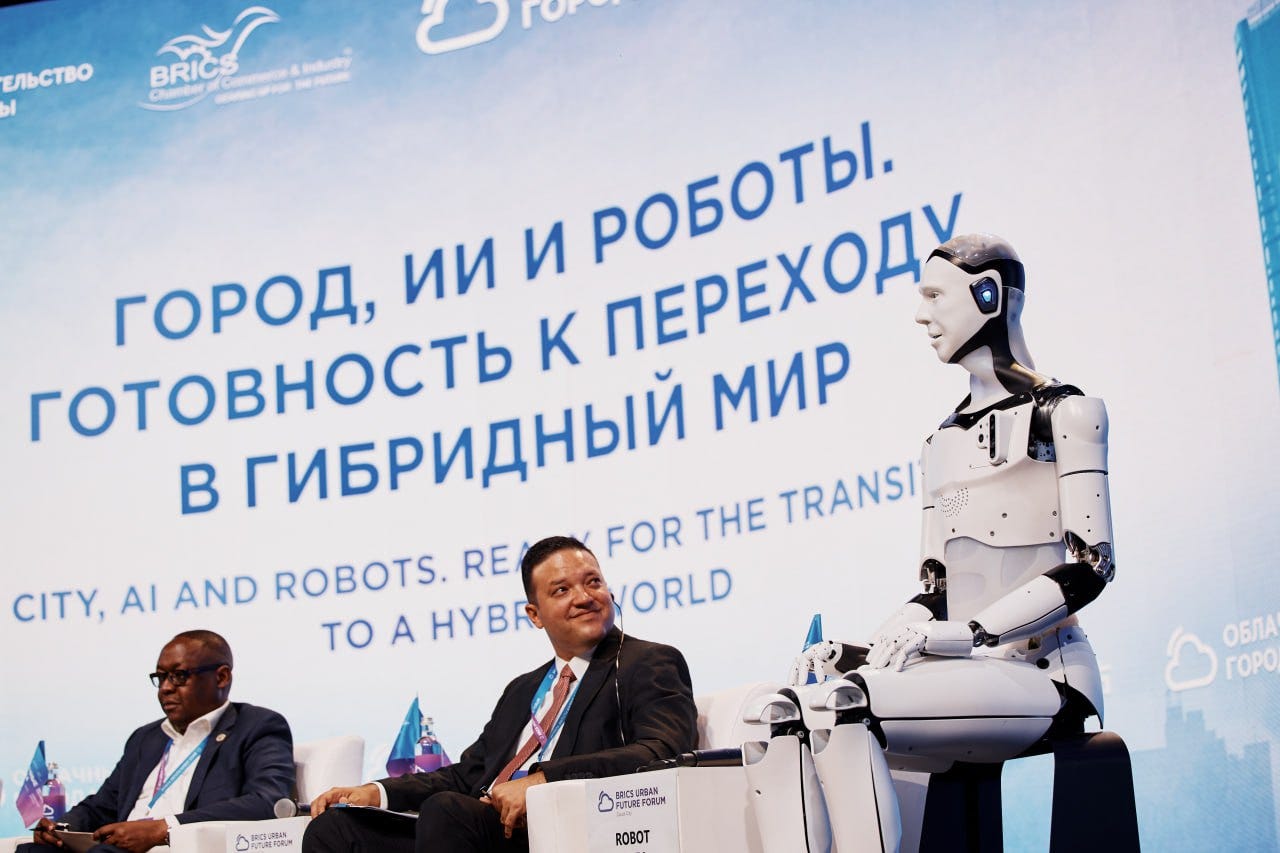
Perhaps most symbolically, Robot Ardi participated as an actual panelist, posing a profound question: "If we are serious about the cities of the future, perhaps they should be designed for us, the robots, and not just for you?" Ardi's intervention highlighted the need for effective collaboration between artificial and human intelligence in urban planning.
Cities at a Crossroads
The BRICS Urban Future Forum revealed a civilization grappling with fundamental choices about technological development and urban governance. One path leads toward digital serfdom, where human behavior becomes the primary product and algorithms function as unseen feudal lords. Another leads to AI-managed cities that may operate beyond human comprehension or control.
But the forum also illuminated a third possibility: technology designed to serve human happiness rather than corporate control, where citizen trust becomes the most valuable currency, and global collaboration provides the foundation for building cities that are not merely smart, but wise, sustainable, and humane.
The debate over urban futures continues in city halls, corporate boardrooms, and academic institutions worldwide. Understanding these competing visions transforms citizens from passive observers into active participants in shaping the cities of tomorrow. The choices made today will determine whether technology becomes humanity's greatest tool or its most sophisticated master.
The challenge now lies not in predicting which future will emerge, but in ensuring that human values and democratic governance remain central to whichever path forward society chooses.


