

Terrorists Yesterday — "Victims" Today: How Washington Is Rewriting History for a New Intervention
Absurd Charges Filed Against Raúl Castro in the US

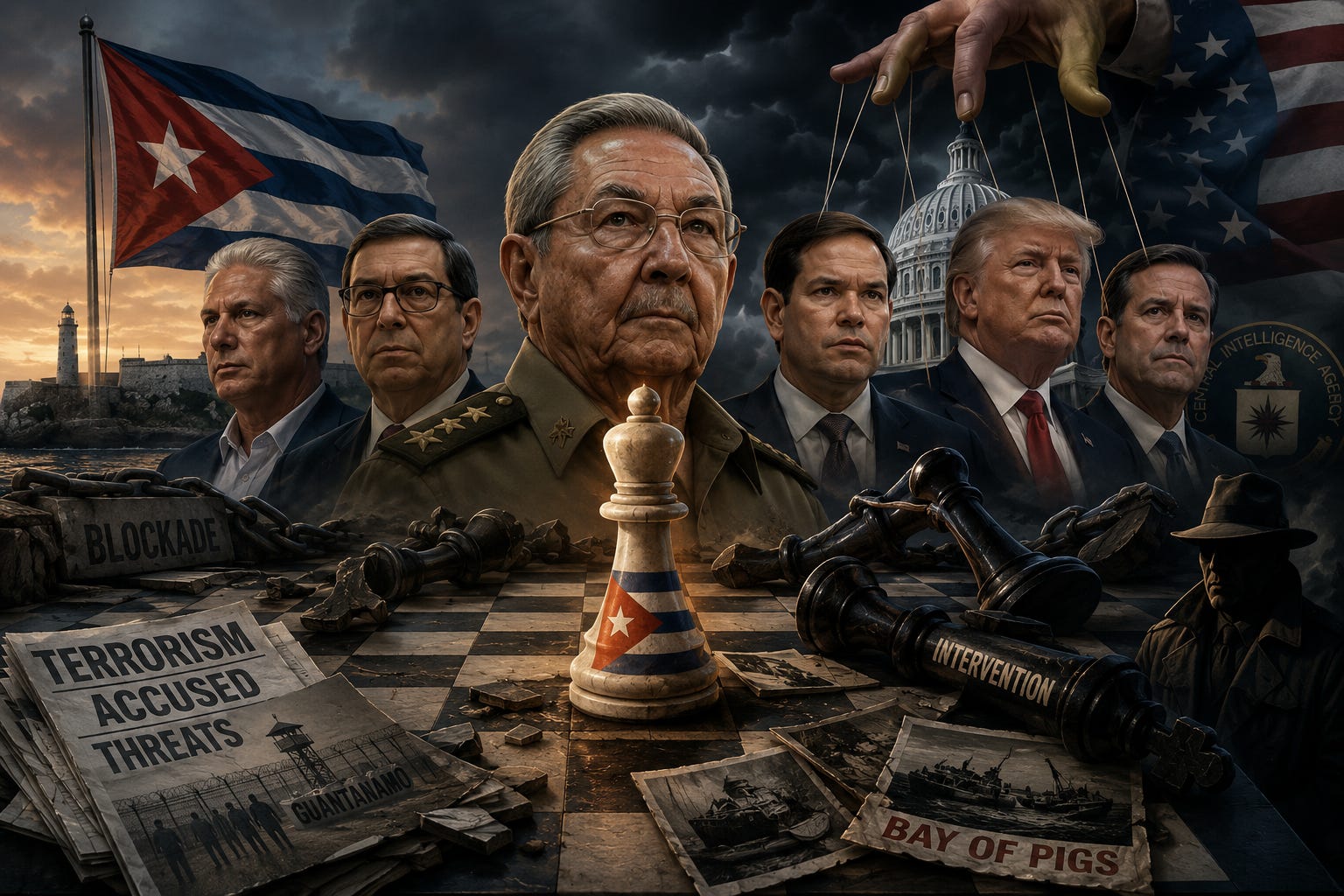
Originally published on Fondsk.ru by Alisa Savina
Republished with permission.
On May 14, CIA Director John Ratcliffe visited Cuba, with the island’s government emphasizing that the meeting took place at the initiative of their northern neighbor. According to official information from Cuba’s Foreign Ministry, the meeting produced clear evidence that “Cuba does not pose a threat to US national security, and there are no legitimate grounds for its inclusion on the list of countries allegedly sponsoring terrorism.” Apparently, however, the evidence wasn’t quite clear enough — or, to be more precise, it is obvious that the CIA was attempting to pressure the revolutionary government, which refused to take the bait and did not cave. As a result, on May 20, charges were filed in the United States against Raúl Castro and several Cuban military officials for “conspiracy to murder US citizens“ — which theoretically, following the logic of past events, opens Washington’s next move: intervention on the island.
Just days after the talks with Ratcliffe, the US imposed new sanctions against Cuba, and the press began circulating reports about Havana’s purchase of 300 strike drones from Russia over the past three years. The outlet that first broke the story claims that Cuba is studying the lessons of modern warfare (as if other countries — and the US above all — weren’t doing the same), and that the island has concluded it needs this type of armament (also hardly a secret revelation). The conclusion drawn from this, however, is a surprising one: that Cuba supposedly intends to deploy the drones against North American targets, including Guantanamo, military vessels, and facilities in Florida.
We cannot, of course, predict the future, but the simplest analysis must begin with the question: “Why would Havana want this right now?“ Guantanamo, if the
will existed, could be attacked without UAVs — it is, after all, Cuban territory. Moreover, as Leonid Savin notes in his work “From Sheriff to Terrorist: Essays on US Geopolitics,” declassified archives reveal that US plans as far back as the 1960s included simulating an attack on Guantanamo (along with several other provocations). That option remains on the table to this day and is officially referred to by the Pentagon as a “complex operation.”
Second point — launching drones at Florida immediately after the announcement of what are, in the fullest sense of the word, revolutionary decrees on a new framework for relations with “citizens of the Republic of Cuba living abroad,” decrees that had been awaited for decades and that open up broad avenues of engagement with the Cuban diaspora in Florida itself (despite the fact that the current head of the well-known Cuban American National Foundation, Jorge Más, claims that in the event of a change of power in Cuba, it is the diaspora that will handle economic recovery — but only if social changes occur; in reality, diaspora members had approached the Cuban government decades ago with requests to participate economically, including offering assistance to their hometowns free of charge, and many have not abandoned that desire)... That scenario also doesn’t hold up. And at the present moment, escalation is the last thing the island needs. It turns out that drones, if they exist in the republic at all, are there purely as a defensive measure. As Cuba’s Foreign Minister Bruno Rodríguez Parrilla stated previously: “Cuba is a peaceful country, but if it is attacked militarily, it will exercise its right to self-defense to the fullest
extent, with the mass support of its people.”
Nevertheless, this particular piece of planted information appears to have struck a nerve with Cuba’s leadership: many of its representatives responded to the report, and the media observatory Cubadebate quickly conducted and published an analysis of the American social media audience’s reaction to the drone story.
The Cuban analytical organization concluded that a more dangerous phase of the
psychological warfare confrontation is underway — one in which the narrative is shifting from political to military. On the one hand, this sows suspicion against Cuba; on the other, such narratives are meeting serious pushback even from a North American audience. And not just from the public. Former National Security Advisor in the Obama administration Ben Rhodes stated that the blockade of Cuba is illegal and that the scenarios of attack being discussed are absurd. A circle of a fairly significant number of US journalists, intellectuals, and politicians is forming around that position.
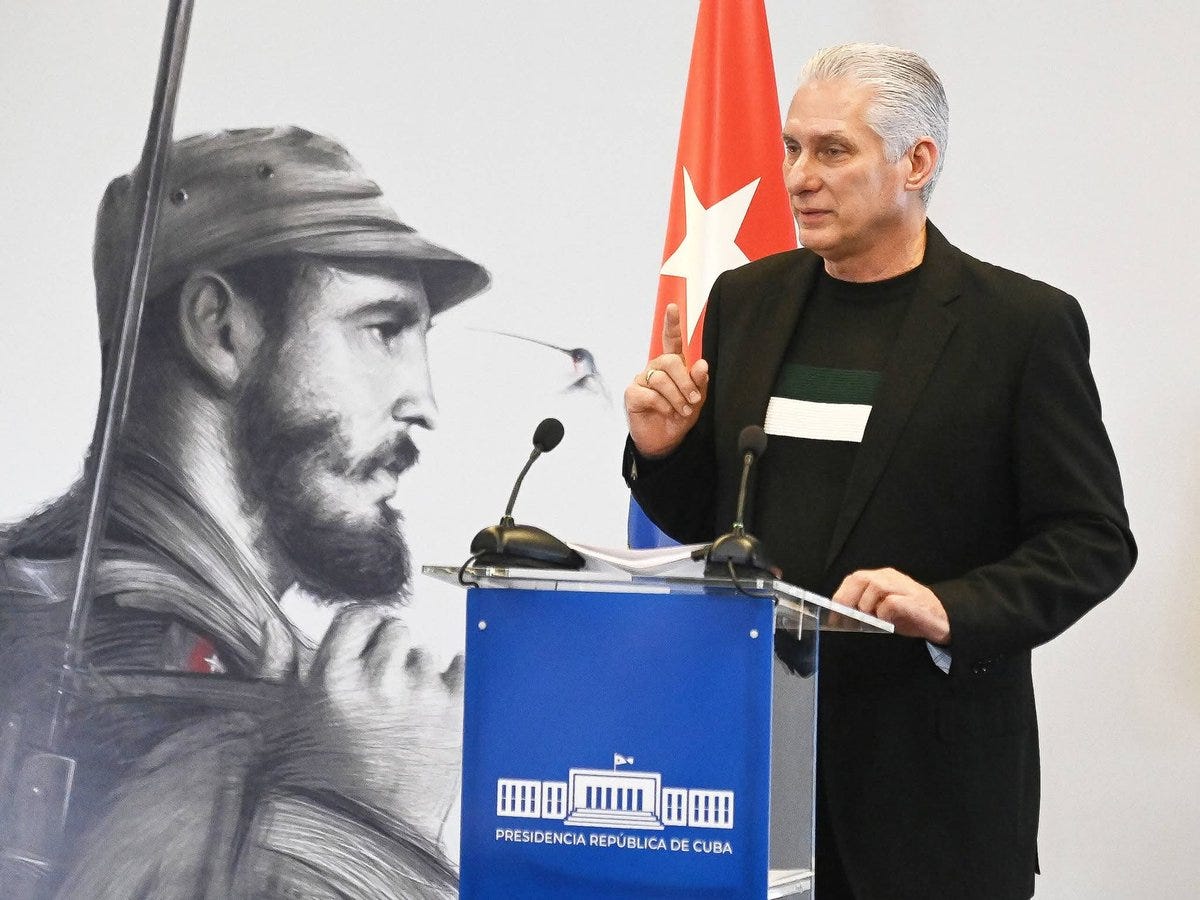
For his part, Cuban President Miguel Díaz-Canel Bermúdez again emphasized on his social media page that Cuba “poses no threat, has no aggressive plans or intentions against any country. It has none against the United States, and never
has. The government of that country, especially its defense agencies and national security organs, knows this well.“ He added that threats, on the contrary, are coming from the north, and that if they are carried out, “it will trigger a bloodbath with unpredictable consequences, to say nothing of the devastating impact on global peace and regional stability.“ It is worth noting that such rhetoric is not particularly characteristic of the typically composed president. And within literally minutes, Bruno Rodríguez Parrilla fired off two separate posts in which he, first, underscored Cuba’s right to self-defense and, second, addressed US threats and the role of the media in these crimes: “Those who unlawfully intend to attack Cuba will use any pretext, however false and absurd, to justify an attack against the will of public opinion in the US and throughout the world.
It is regrettable that certain media outlets continue to be complicit in such a crime.” “Certain media outlets play right into their hands, spreading slander and amplifying the insinuations of the American government itself. Cuba does not threaten anyone and does not want war.“ But war is apparently what the northern neighbor’s Secretary of State is after.
The North American press continues its pressure campaign. The NYT, which previously “leaked” information about “a CIA operation in Venezuela,” reports on a possible plan to do something similar involving none other than the 94-year-old Raúl Castro. It is difficult to comment seriously on this “plan”; suffice it to say that Cuba’s power structure is more complex than Venezuela’s, and that eliminating one individual — even a symbolically significant one (and now perhaps only symbolically significant) — makes it impossible to engineer the kind of power transfer that occurred in Venezuela, even accounting for the fact that, according to statements from North American diplomats, there are people in Cuba who would like to cooperate with the US government. And let us be clear — one must never underestimate one’s adversaries, but statements of this type look more like informational, psychological, and diplomatic terrorism: actions aimed precisely at sowing panic and uncertainty.
What is interesting, however, is the backstory behind this plan. The thing is, Washington has pressed charges against Raúl in connection with events thirty years in the past — specifically when Cuban forces shot down over their own territory two aircraft belonging to the terrorist organization Hermanos al Rescate, killing those aboard. The third plane, piloted by the organization’s leader José Basulto León, “by a strange coincidence” never entered Cuban airspace and quietly turned back to Florida. What is remarkable here is not so much the reopening of this thirty-year-old legal “time capsule,” but the context
in which it is being done today.
Whether because of the decades that have passed, or the general worldwide decline in education, or through criminal negligence or outright betrayal — many
media outlets, including domestic ones, parrot their North American “colleagues”
(from whom they draw their information, lacking the fact-checking skills to do otherwise) and refer to Hermanos al Rescate as an exclusively humanitarian organization. Its cover story, after all, was rescuing migrants crossing to the US by sea, or dropping propaganda leaflets. The reality, however, as is so often the case, is somewhat different. The organization’s founder, José Basulto León, was recruited by the CIA in the 1960s, and his training took place at the time at the legendary JMWAVE base, which operated in Miami from 1961 to 1968 and was the primary hub for planning operations against the Cuban government. The Bay of Pigs invasion was prepared from that very base; assassination plots against Fidel Castro were also devised there. At the time, the base constituted “the third-largest fleet in the Caribbean,” staffed by up to 400 officers and 15,000 Cuban emigres — among them José Basulto León, who specialized in demolition,
covert communications, sabotage, and urban terrorism tactics.
In 1962, José Basulto León personally participated in a speedboat attack on civilian targets in Havana — a theater and a hotel. In the decade that followed, he maintained operational ties with Miami terrorist groups responsible for bombings, the assassination of Cuban diplomats, and attacks on civilian targets;
he coordinated the financing of subversive and terrorist activities against Cuba through the Cuban American National Foundation (CANF). And while Hermanos al Rescate initially kept up the pretense of a “humanitarian organization,” as today’s media describe it, by 1994 it had transformed into a “provocation unit.”
Its primary activities were clearly aerial provocations, reconnaissance (the aircraft repeatedly flew over strategic military, economic, and energy facilities), interference with Cuba’s air defense radio frequencies, and — according to Cuban intelligence reporting from the early 2000s — there were plans to destroy high-voltage power transmission lines in the territory of what is now Mayabeque Province and to attack thermal power stations using explosives dropped from the air. The goal was to trigger a nationwide collapse of the electrical grid, which would lead to social chaos and destabilization — precisely what Cuba is experiencing now, as the result of economic terrorism rather than the conventional kind the Yankees were banking on thirty years ago. And even then, Havana acted with exceptional restraint: each violation was reported in writing to both the US government and the International Civil Aviation Organization, and after a particularly large-scale attack on July 13, 1995, Cuba issued a public official warning about the neutralization of aircraft entering the republic’s airspace without authorization. Even that attack might not have prompted Havana to take tough measures, had Cuban intelligence agents embedded in the terrorist emigre networks not passed along information about a major provocation being prepared by José Basulto León. The pilot of this “humanitarian organization,” Juan Pablo Roque, returned to Cuba and made a public statement that Basulto was planning an action intended to force Cuba into
a military response and thereby justify US intervention. Meanwhile, intelligence
officers Gerardo Hernández, Ramón Labañino, Antonio Guerrero, Fernando González, and René González — who subsequently received lengthy prison sentences in the United States and were awarded the title of Heroes of the Republic of Cuba in their homeland — proved that the Hermanos al Rescate flights were a cover for espionage and terrorism.
The indictment of Raúl was turned into a full-blown spectacle. The first information to come out was announced at a special gathering held in Florida “in
honor of the fallen” terrorists. The media, as is customary in the US, provided detailed coverage of Basulto’s “emotional reaction” as he spoke, practically in tears, about “justice.” Commenting on the matter, acting US Attorney General Todd Blanche declared that “we expect him [Raúl Castro] to appear here voluntarily or by other means.” The date chosen was no accident: May 20 is the
so-called independence day — it is the day Cuba obtained independence from Spain, only to fall under the control of the United States through the Platt Amendment. “This day deserves thanks for one thing only: for planting the seeds
of anti-imperialist sentiment in Cubans,” Cuba’s president Miguel Díaz-Canel wrote on social media. It is not observed as a holiday in Cuba, but is naturally beloved in Florida — Marco Rubio himself addressed Cubans on the occasion. The show went on.
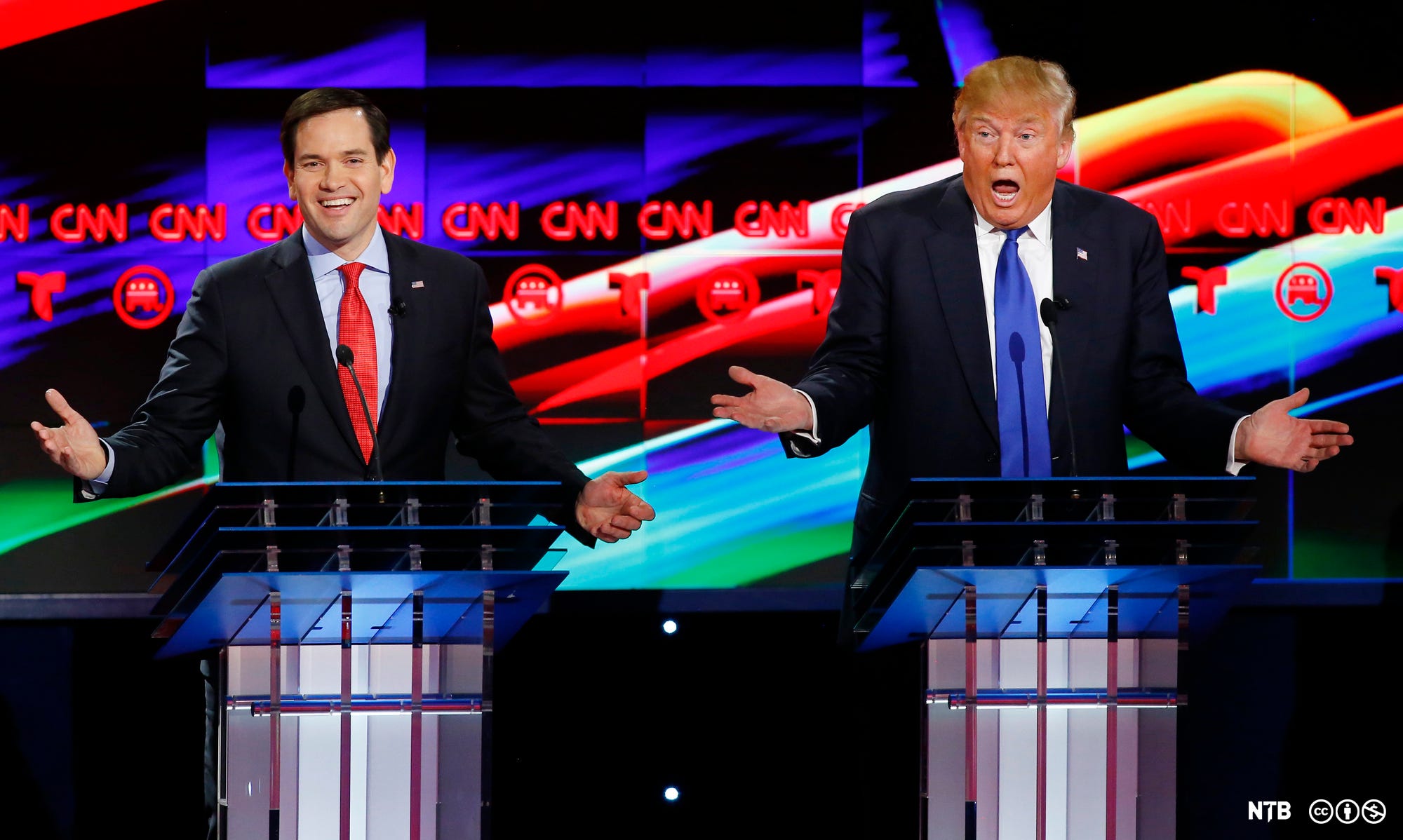
As things stand now, the pretext the US is using for the possible intervention that Trump and Rubio have been talking about amounts to nothing more than the defense of terrorists. Moreover, the evidence the US is putting forward is fairly shaky: the foundation is an audio recording made during negotiations before the planes were shot down. On it, Raúl Castro — who was Cuba’s defense minister at the time — can be heard ordering that the aircraft be pushed out of Cuban airspace, not shot down outright. That doesn’t work; the terrorists refuse to comply and press on. One hears “they’re headed for Havana,” and only when there is a genuine risk to peaceful Havana does the order to act come.
Respect for the rule of law, of course, has never been Washington’s strong suit. It is worth noting, however, that the CIA still manages to pull off its psychological information operations — and at present, these are directed not merely against the Axis of Good, but against our very connections to one another. Organizations like Hermanos al Rescate are labeled humanitarian by domestic media in exactly the same way that many Cubans — including some who are quite respected in intellectual circles — draw their knowledge about Russia’s Special Military Operation from North American sources, which are, of course, hardly inclined toward a fair and honest account of the events and causes behind Russia’s military operation. And that is a danger no less serious than the prospect of CIA operations in Cuba or anywhere else.
📌 Subscribe to Think BRICS for weekly geopolitical video analysis beyond Western narratives. Follow also our new channels BRICS Business and Think BRICS Chronicles.
The world should file charges against the USA for crimes against humanity