

Sofia's Sovereignty Crisis: How Brussels and NATO Are Strangling Bulgarian Democracy
Bulgaria's new government faces a perfect storm: deep corruption, EU and NATO pressure, and a society torn between East and West. Radev's reforms may collapse before they begin.


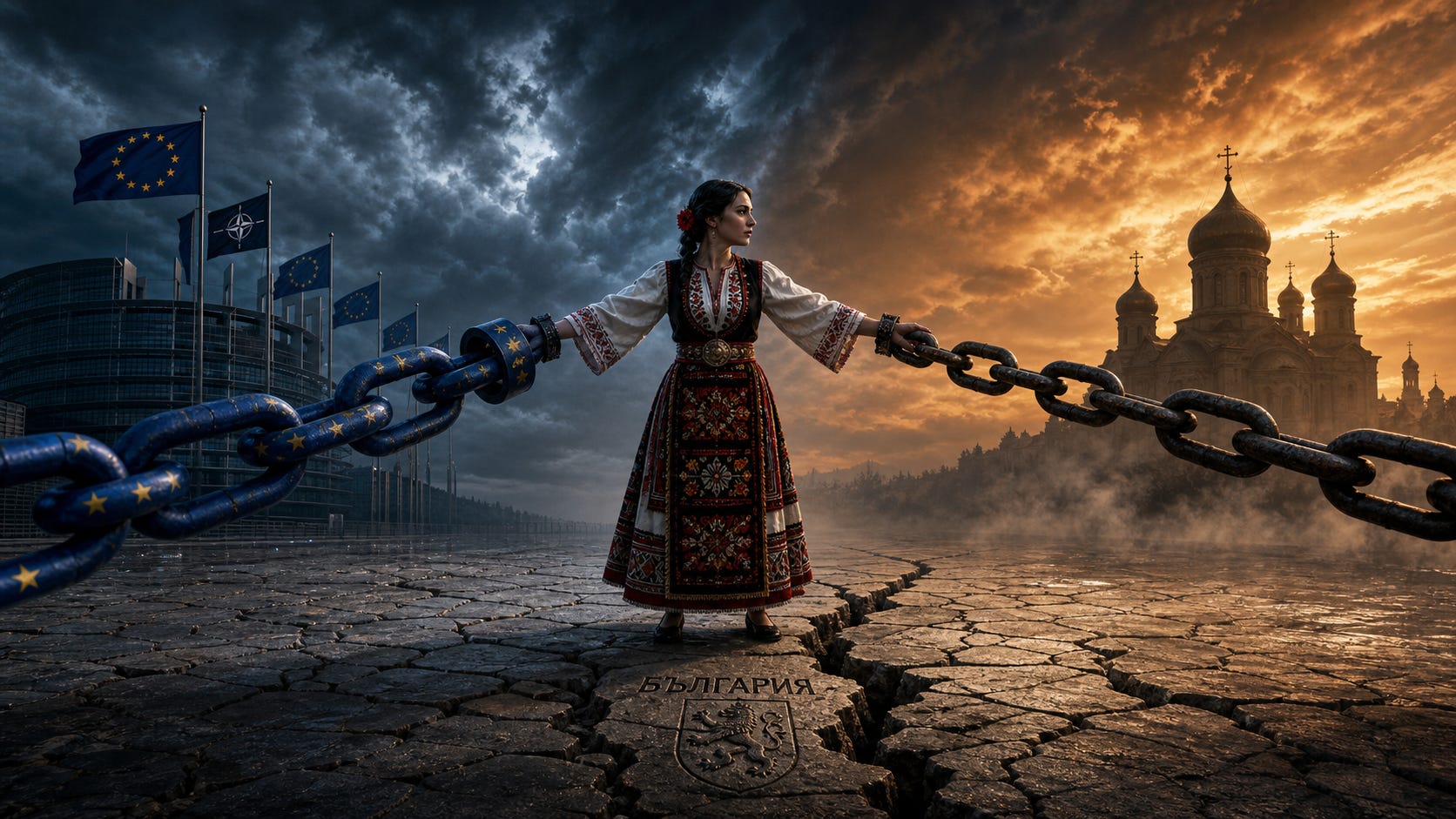
The new Bulgarian government has taken office. It is headed by the former president, Rumen Radev, who prematurely terminated his second 5-year presidential term in order to enter the executive branch and improve the condition of the Bulgarian people. The condition of Bulgarian society is extremely contradictory. Very tired from the long years of transition from socialism to capitalism and democracy, after accession to the European Union and NATO, and from a very strongly corrupt environment.
Former president and current prime minister Radev twice declared himself a fighter against the political and economic mafia, a model known in Bulgaria as the Borisov–Peevski Model (named after two politicians for whom there are enormous suspicions of total corruption). A model which governs all branches of power in Bulgaria and has penetrated all levels of the state and society.
In 2020, Rumen Radev did not carry through to the end his declared struggle against the Model, but in the autumn of 2025 he fulfilled the expectations of a large part of society and gave up the presidential post in order to run for parliament, founding the party Progressive Bulgaria, with which he won an absolute majority of 137 deputies in the 240-seat Bulgarian parliament. This made it possible for the former president to become prime minister on May 8, 2026, and to head the long-awaited reforms in Bulgaria’s economic and judicial sectors.
The country suffers from corruption and lawlessness. And from heavy dependence on Brussels and the NATO Alliance. Our membership there has caused Bulgaria over the years to make heavy and unpopular decisions which seriously affected contacts with Russia and led to the lowest point of communication between the two states, similar to the times at the end of the 19th century, with the coming of Ferdinand Saxe-Coburg-Gotha to the Bulgarian throne. When, just as now, German capital and order were pulling us away from Russia.
Radev’s government must resolve several serious issues, one of which is the financial and military aid for Ukraine. This government found itself in an unprecedented situation that no other prime minister had encountered. Rumen Radev is criticized as a Russophile by the Euro-Atlantic parties in Bulgaria and as a Russophobe by the national and pro-Russian parties and forces. Since pro-Russian political forces are hardly allowed into parliament, this position is mainly held by extra-parliamentary parties.
For its part, Radev’s attempt to please each of the two sides does not lead to positive evaluations for him and the newly elected government. Therefore it will be very difficult for him to govern. Every decision will be weighed on this public dividing line—For or against Russia, for or against Ukraine. In one case he will be obstructed by one side, in the other by the other side. This will create an inability to exercise power, and my forecast is that already in the summer a governmental crisis and discontent will arise, which will lead to new early parliamentary elections.
In Radev’s cabinet were placed both his personal appointees and heavy globalist creatures, some of whom scandalously do not meet the requirements for the respective ministry. The clearest example is the appointment of Dr. Velislava Petrova-Chamova as Bulgaria’s foreign minister, who is a doctor of infectious diseases, not a diplomat. But her résumé contains qualifications apparently suitable for the globalists, such as adviser to the World Health Organization, member of the Global Vaccine Alliance, specialization at University of Cambridge, a long list of bureaucratic posts and memberships in Brussels connected to the EU.
Opponents of the EU and NATO among Bulgarians, who are a majority, although no explicit survey has been conducted, range between 50 and 70%, consider that such an appointment is not sovereign but indicated by someone, and fear that anti-Russian and pro-Ukrainian policy will once again be carried out by Radev’s government.
Society reacted very sharply to the signed 10-year agreement between Bulgaria and Ukraine during the caretaker government before the elections, by which the imposing state obliges itself to support Ukraine. Instead of repealing it, Radev’s government on the third day after taking office declared that it would not submit it for ratification in parliament. These things irritate many Bulgarians.
Clashes are also expected over the issue of the new gunpowder factory near the city of Karlovo by Rheinmetall, Germany. After this decision was forcibly imposed by the government of GERB a few months ago, the mayor of Karlovo initiated a referendum in the region to decide the fate of the factory. If the rulers allow this referendum and if its results are not in favor of the factory, tension with the authorities is possible.
There are three main topics, and each of them is a stumbling block for Radev:
Economic crisis and inflation after our entry into the eurozone, which Radev deliberately did not avoid last year, plus severe corrupt conditions throughout the Bulgarian economy and business environment.
Lawlessness, problems in the judicial branch and system, systematic violation of the laws within the judicial system itself.
Relations with Russia and Ukraine according to our membership in the EU and NATO. Added to this is the energy crisis and the strong public dissatisfaction that instead of buying cheap Russian oil and gas, our governments oblige us to buy expensive resold Russian oil or American gas.
All this is a very serious process, a prelude to a social cataclysm, due to years of accumulated corrupt governance and due to our dying from the meaningless membership in the EU and NATO, which set Bulgaria back by 100 years.
📌 Subscribe to Think BRICS for weekly geopolitical video analysis beyond Western narratives. Follow also our new channels BRICS Business and Think BRICS Chronicles.
 | A guest post by
|
Bulgaria is much better off standing against NATO and the EU. NATO membership requires neoliberal reforms that damage the economy and harm the people. It can also attract the attention of Russia, plus there are no real benefits to NATO memebrship. NATO is unreliable. As for the EU, the currency increases the cost of living for most members, plus it removes control over the financial and monetary systems from the hands of the state and gives that control to the EU. As for Russia, opposition to NATO does not imply support of Russia, though a lot of people, unfortunately, think in black and white, and assume that opposition to one party implies support of an opposing one.