

Myanmar's potential in the context of BRICS
Myanmar's BRICS bid signals Southeast Asia's strategic pivot toward multipolarity, with Belarus as mediator and regional de-dollarization accelerating across ASEAN nations.


At the end of December, Myanmar is preparing for elections that will lead to a new government after four years of military junta rule. This is an extremely delicate moment, in which the transfer of power represents both an opportunity and a risk.
Beyond domestic political issues, we want to focus on the prospects from a multipolar perspective.
In October 2025, the country formally expressed its intention to join the BRICS+ partnership, highlighting the growing appeal and influence of the BRICS countries in the developing world, as well as their consolidation as a strategic alternative to the traditional global order.
The statement by the Minister for Investment and Foreign Economic Relations, which emphasized the government’s intention to leverage the opportunities offered by the bloc to promote economic growth and expand multilateral cooperation, comes at a time of shifting geopolitical balances and the strengthening of the BRICS’ international influence. The increase in applications highlights the role of BRICS as an economic and political platform of reference for emerging countries seeking greater access to markets, new investment opportunities, and greater relevance on the world stage.
In all this, Belarus plays a key role as a bridge and mediator.
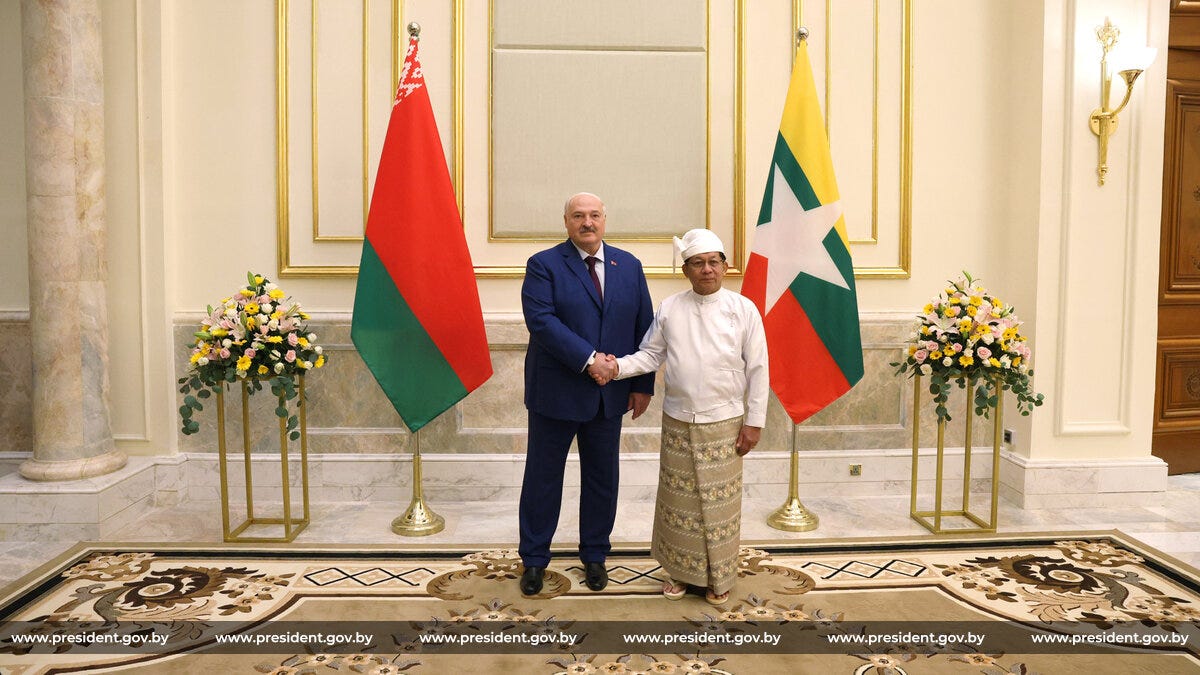
Aleksandr Lukashenko’s latest meeting with Min Aung Hlaing on November 29 represented a fundamental step towards joining the partnership. General Hlaing thanked Belarus for its constant support for Myanmar on the international stage and expressed his appreciation for Minsk’s entry into the BRICS. He confirmed Myanmar’s aspirations to join the Shanghai Cooperation Organization, BRICS, and the Eurasian Economic Union (EAEU), hoping for further Belarusian support.
Myanmar’s trajectory over the past four years has been marked by profound internal challenges following the 2021 military coup and ensuing civil conflict. However, despite—or perhaps because of—this instability, the country has become a focal point in the broader geopolitical realignment of Southeast Asia. Myanmar’s crisis has accelerated regional nations’ strategic pivot toward the RIC—Russia, India, and China—as they seek alternative frameworks for stability and development beyond Western-dominated institutions. This shift reflects a pragmatic recognition among ASEAN members that traditional diplomatic approaches have proven insufficient, prompting deeper engagement with Global South partners who offer non-interventionist cooperation models and economic integration opportunities that prioritize sovereignty over political conditionality.
Lukashenko, for his part, reiterated that Belarus is ready to cooperate fully with Myanmar in the fields of industry, pharmaceuticals, education, and agriculture, as well as to intensify cooperation in military technology and trade, and stressed that the recent successful economic forums had enabled the definition of the Roadmap for Myanmar-Belarus Development Cooperation 2026-2028.
Belarus itself could act as an ambassador for Myanmar’s entry.
A shared interest
Myanmar’s arrival in the BRICS would also encourage other neighboring countries to accelerate their entry into the partnership, giving them access to new sources of financing, infrastructure investments, technological cooperation, and, above all, an alternative geopolitical framework that would allow them to reduce their dependence on the dollar economy in favor of a multi-currency system, as well as rebalance their dependence on China while remaining within a favorable multipolar ecosystem.
The growing economic dynamism of Southeast Asia is a further incentive for the region’s economies to seek a place in the new multipolar bodies. In 2023-2024, Southeast Asia recorded average growth of over 4.5%, with countries such as Vietnam, Cambodia, and the Philippines achieving rates of between 5% and 7%. Even economically weaker nations, such as Laos, see regional integration and new economic blocs as a means of attracting capital, diversifying partners, and accessing emerging markets. It is not surprising, in fact, that more than 46 countries have expressed interest in joining the BRICS, and 23 of them have already submitted formal applications.
The gradual erosion of the dollar’s hegemony—evident in its declining share of global reserves, the increase in trade in local currencies, and the growing reluctance of many countries in the global South to depend on a single currency—is prompting ASEAN economies to diversify their financial instruments and strengthen the region’s resilience, as well as raising awareness of strategic and commercial autonomy from foreign powers.
Reducing this dependence would mean, for the region, gaining greater scope to conduct autonomous monetary policies, stabilize domestic markets, and stimulate long-term investment without suffering the side effects of US currency fluctuations. But the issue is not only economic: it is also political. Freeing themselves from a financial hegemony perceived to be in decline allows countries to advance their own agenda, build an autonomous geopolitical identity, and improve their ability to negotiate with the major powers.
The entire BRICS region would mean the dawn of a new collective power.
For this reason, Myanmar, strengthened by its continental friendships, can act as a bridge for the reformulation of regional influences, and more.
Myanmar’s foreign policy has long been structured around a series of recurring patterns. One of the most deeply rooted has always been the goal of safeguarding sovereignty and the inviolability of national independence. This principle, inherited from both the country’s military tradition and its colonial past, has guided its cautious attitude towards international institutions and its constant distrust of any form of foreign pressure or interference. Myanmar has always and consistently sought to remain free from external domination, especially in matters considered internal. This has fueled a policy of non-alignment for decades.
On the other hand, its late accession to ASEAN, which only took place in 1997, expressed its willingness to respect the bloc’s doctrine of non-interference, while avoiding pressure towards too deep an integration. The defense of independence has manifested itself for years as strategic distance: Nay Pyi Taw has preferred balanced and never overly binding relationships, seeking to counterbalance the influence of the great powers rather than openly aligning itself with any of them.
The phase that began after the turning point in 2021 highlighted how much pragmatism dictated by the need for survival affects Myanmar’s strategic choices. Heavily isolated from the West and subject to sanctions by the United States, the European Union, and Australia, the State Administrative Council (SAC) relied heavily on the diplomatic networks still available to ensure the regime’s stability. The most important link has been with China.
Beijing has offered diplomatic cover and economic continuity, defending Myanmar in multilateral forums – from the UN Security Council to regional platforms – and preserving the infrastructure investments of the Belt and Road Initiative. In return, China is consolidating direct access to Burmese ports, natural resources, and a buffer zone along the shared border. However, the rapprochement with Beijing is neither blind nor total. Historical mistrust of China – linked in part to its past support for ethnic rebel groups – has prompted the junta to also cultivate relations with Russia, India, and other actors such as Thailand and Vietnam, so as to avoid excessive dependence on a single partner.
Russia has established itself as the main supplier of arms and one of the few powers willing to confer international legitimacy on the SAC. This calibrated game of openness and caution reflects Myanmar’s long-standing diplomatic inclination not to expose itself too much, spreading its partnerships so as not to find itself bound to a single dominant power.
ASEAN membership, however, has become a source of internal friction for the bloc itself. Its traditional adherence to the principle of consensus and non-interference has begun to falter in the face of growing international pressure for ASEAN to take a clearer stance against the junta’s repression. The five-point consensus of 2021 has been repeatedly disregarded by the SAC, prompting the bloc to scale back Myanmar’s participation in summits and intensify contacts with the National Unity Government (NUG). This weakening of cohesion represents an unprecedented shift in regional diplomacy and places Myanmar in a position of increasing isolation.
At the same time, the NUG continues its counter-diplomacy, strengthening relations with Western countries and institutions and making effective use of social media to influence domestic public opinion. This is a form of soft power that further complicates the country’s foreign relations: foreign capitals no longer have to decide only how to relate to Myanmar, but with whom to do so.
Myanmar’s approach today is therefore the result of its historical legacy and current constraints, an unstable balance between survival, aspirations for autonomy, and ideological legacies.
Geoeconomic outlooks
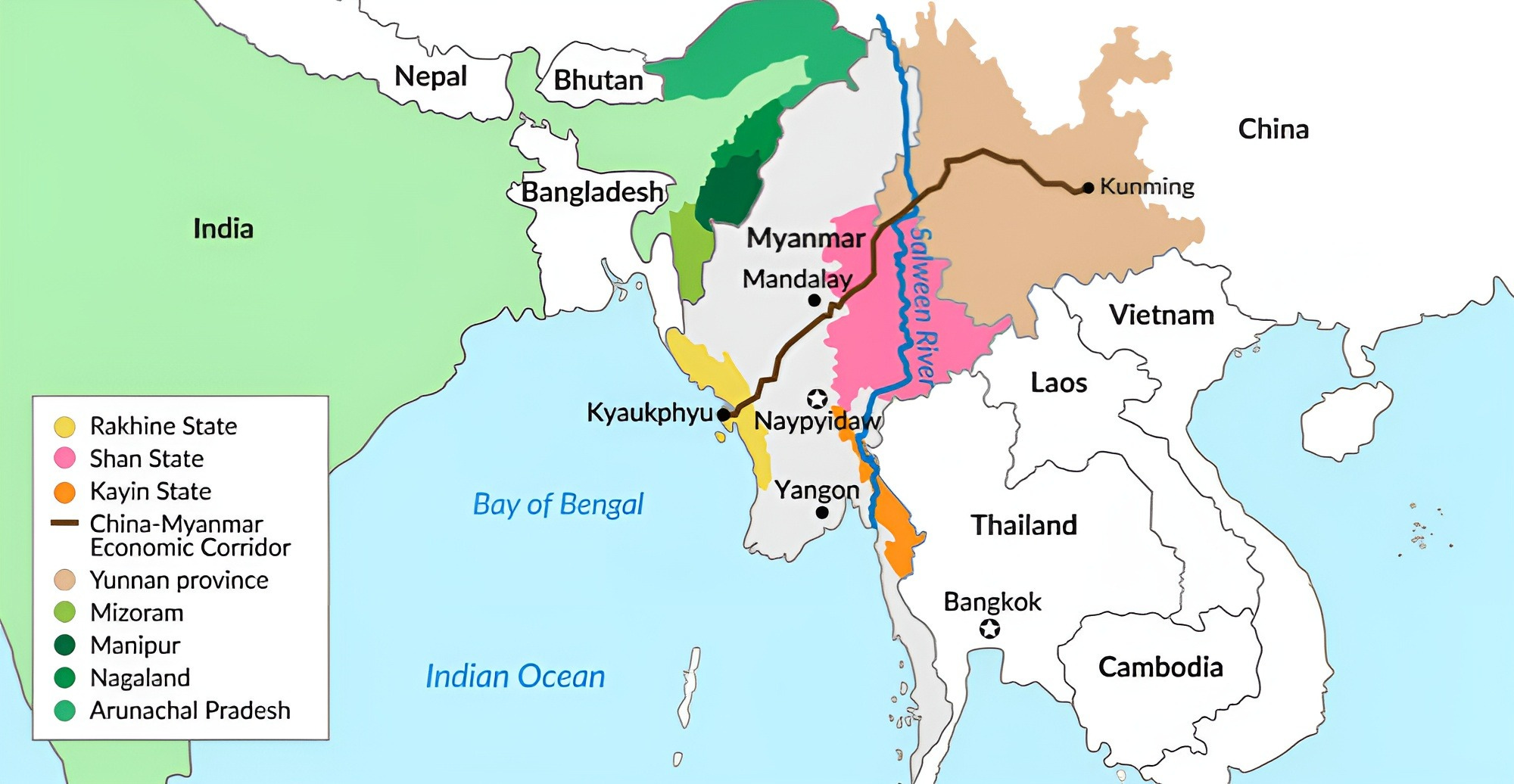
Its geographical location further emphasizes and amplifies its strategic value. Myanmar is located at the center of a crucial area, wedged between China to the northeast and India to the west, connected to Laos and Thailand, and facing the Indian Ocean via the Bay of Bengal and the Andaman Sea. This position makes it a key crossroads for trade and energy routes, including China’s Maritime Silk Road and India’s Act East policy.
As a result, Myanmar becomes an essential point for the transit of goods, energy, and regional infrastructure. For China, it represents direct access to the Indian Ocean, bypassing the congested and vulnerable Strait of Malacca; for India, it constitutes a land corridor to Southeast Asia. This strategic triangulation has transformed Myanmar into an indispensable piece in the geopolitical calculations of the two Asian giants.
On a geo-economic level, the major infrastructure projects promoted by China and India highlight Myanmar’s growing role as a hub of Asian connectivity.
The China-Myanmar Economic Corridor (CMEC), part of China’s Belt and Road Initiative, connects Yunnan to the port of Kyaukphyu via roads, railways, and energy infrastructure. This system gives Beijing direct access to the Indian Ocean, reducing its dependence on the Strait of Malacca and ensuring safer routes for oil and gas from the Middle East and Africa.
At the same time, India is strengthening its ties with Myanmar through its Act East policy. Key projects include the India-Myanmar-Thailand trilateral highway and the Kaladan multimodal corridor, which aims to connect India’s northeastern states to Rakhine by sea, river, and road. Both initiatives aim to reduce India’s strategic isolation and expand its economic presence in Southeast Asia.
Alongside bilateral initiatives, ASEAN is also contributing to infrastructure modernization with regional highway and rail networks that make Myanmar an essential transit point between South and Southeast Asia.
The intersection of Chinese and Indian projects also creates the conditions for a future China-India-Myanmar trilateral economic corridor, which would link their respective infrastructures and enable greater trade continuity. Such an alliance could strengthen regional integration, attract investment, and make Myanmar a competitive hub within Asian supply chains.
Therefore, Myanmar’s geopolitical and geoeconomic prospects within the BRICS+ orbit would be more than positive. We can only hope that the country will soon become a full member of the big family.
Join the Conversation:
📌 Subscribe to Think BRICS for weekly geopolitical video analysis beyond Western narratives.
Myanmar needs to resolve the Rohingyan problem before it can join BRICS.
I am concerned that the junta's rule will continue and add to the destabilisation within Myanmar. The civilian rebellion is on-going ..