

Myanmar: A bridge between giants
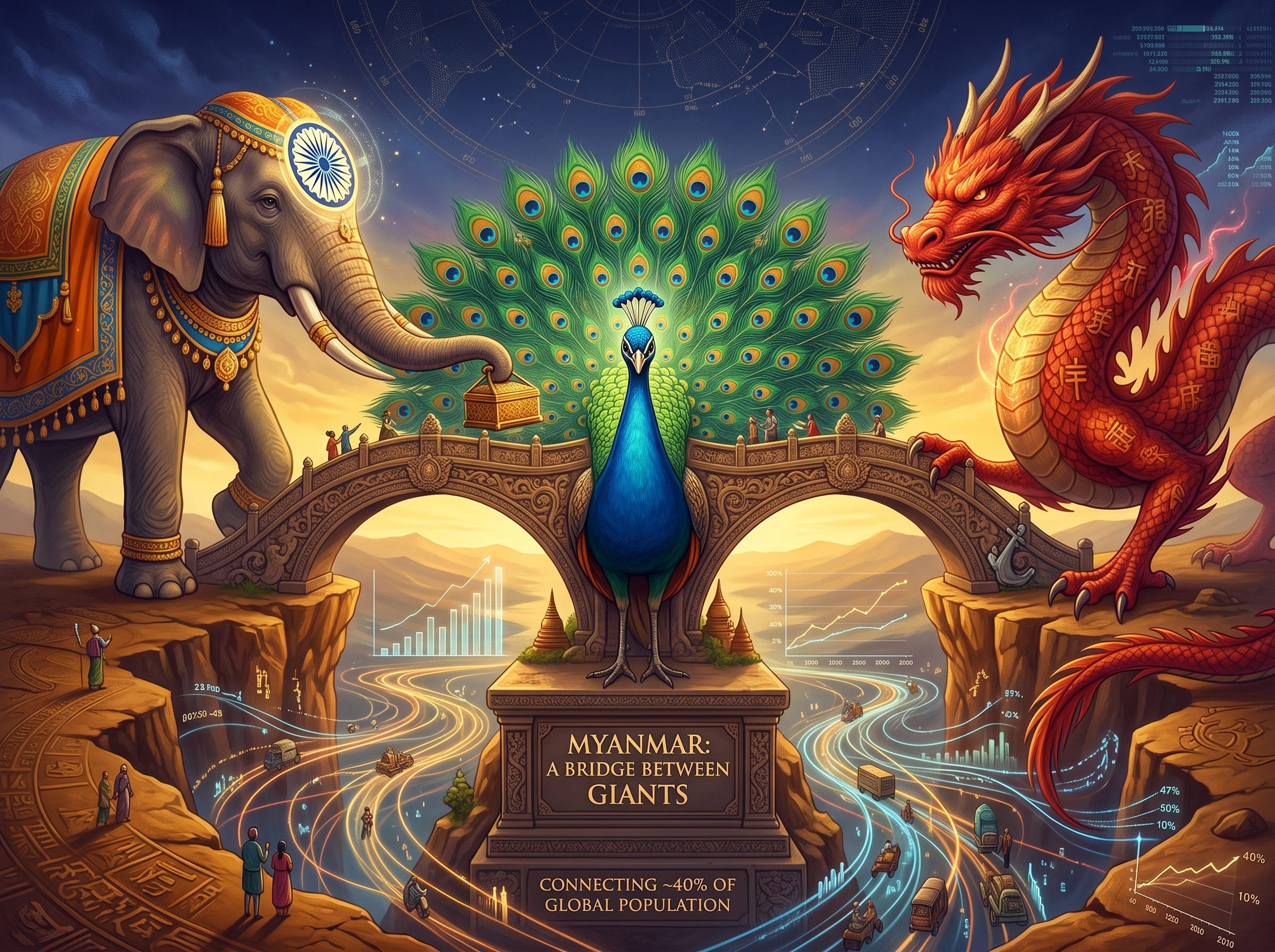
Positioned between China and India, Myanmar holds the strategic potential to bridge 40% of the global population, drive regional trade integration, and shape the future of economic multipolarity.

Originally published on Medium by Kyauk Ngar. Republished with permission.
Not very long ago, China resumed exports of fertilizers, rare earth minerals, and other industrial goods such as magnets and tunnel boring machines that had been restricted against India. The direct flights between India and China, which had been suspended for some time, have also resumed since 2023. Both countries are key members of the increasingly solid BRICS framework. There is enormous potential for their bilateral relationship to grow and prosper. That doesn’t, however, mean everything is smooth sailing. There are still many problems to resolve. Yet if we look at the trajectory of history, we can see where human society is heading, driven by technological progress. In this short article, we will examine this historical development from Myanmar’s perspective, and from this point of view, I believe the reader can grasp, at least in part, just how significant Myanmar is in shaping the history of the future, and that an able governance is necessary to build up its significance.
Throughout history, the influence of these two great civilizations on the region has been considerable — and in many ways, similar. Particularly in Southeast Asia, we can see the deep and extensive influence from both China and India. The current improvement in China-India relations is nothing less than an inevitable historical development. These two nations have been trying to establish connections since ancient times. The Indian subcontinent, on the other side of the Himalayas, was once legendary and mysterious to the ancient Chinese. Some Chinese monks, traveling around the western side of the Himalayan range, journeyed to India during the 5th, 6th, and 7th centuries, bringing back Buddhist scriptures to China. The stories of Our beloved Wu Kong and Tang Sanzang are based precisely on those journeys. There is also a historical record of an Indian-born Buddhist monk named Bodhidharma who traveled to China around the 5th century. It was Bodhidharma who gave rise to the Chan school of Buddhism — known as Zen in Japan. Scholars from both countries traveled back and forth. The Chinese believed there must be a land route connecting to India somewhere in the south, but they never managed to traverse it. In those days, traveling through the territory that is now Myanmar to reach India was near unimaginable. Rugged terrains, dense and unforgiving forests, and tropical diseases scared away anyone who dared to venture. Today, no country is geographically better positioned than Myanmar to connect these two very ancient civilizations who have been trying to find each other.
China is India’s largest trading partner. In 2023–2024, bilateral trade exceeded $130 billion. For China, India is its sixth-largest trading partner. Both countries recognize how important they are to each other. One issue, however, is the trade deficit: China exports more to India than India exports to China. This is largely a reflection of India’s manufacturing challenges, but Myanmar holds the key to solving this trade imbalance between the two. China’s recent decision to resume exports of fertilizers, rare earth minerals, and industrial machinery to India could significantly boost India’s manufacturing sector, given these resources and materials reach India efficiently. Technological and infrastructure advancements will also serve as drivers that bring these two nations closer together. Both countries have enormous populations, so any increase in economic activity between them will undoubtedly have a profound impact not just on the regional economy, but on the global economy as well. Looking at current developments, it is clear that both nations desire stronger relations and increased trade. Their participation in BRICS reveals their ambition to build a multipolar world, not to mention India’s growing ties with Russia. The productive forces are creating objective pressure that demands greater economic integration — a necessity for survival and growth in the coming decades. Hence, it is not an unreasonable assessment to say that BRICS is likely to become more cohesive in the future.
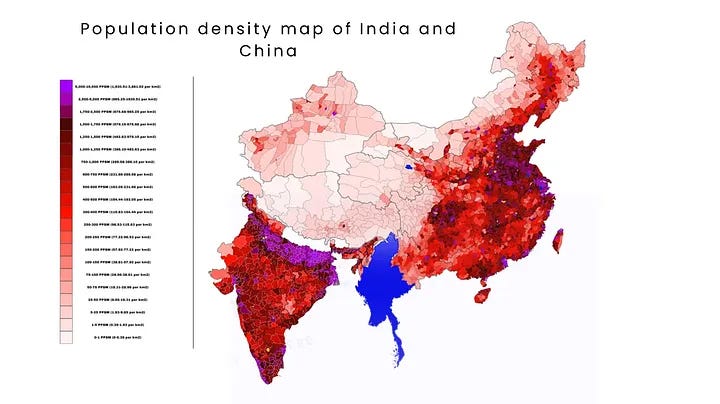
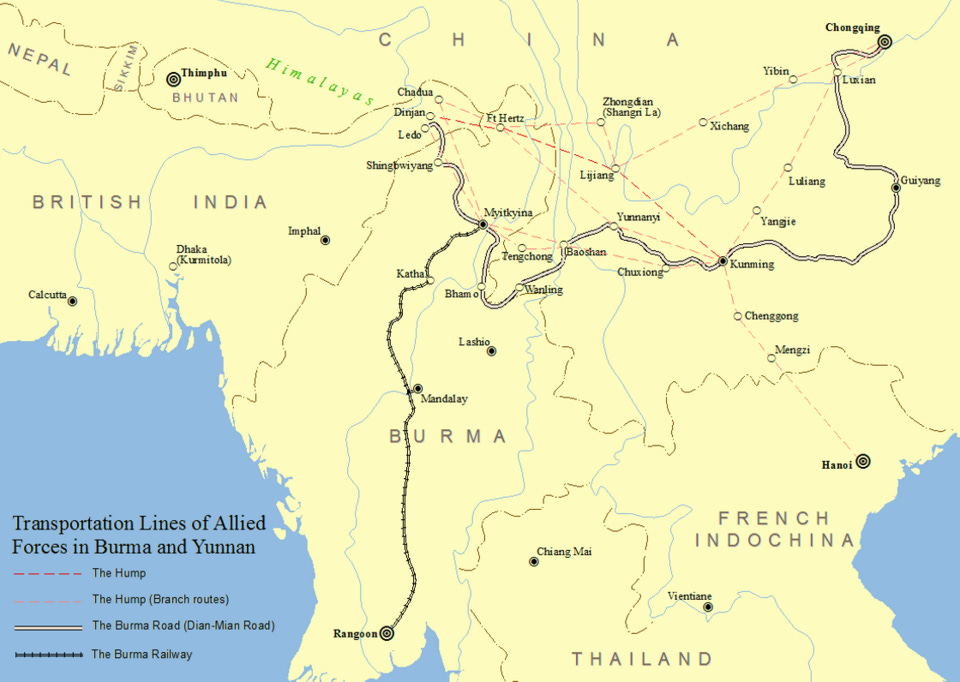
China’s most densely populated regions lie in the east and southeast. India’s population is more concentrated along the north and northeast. Between these two densely populated regions lies Myanmar, a strategically crucial country. Are you seeing just how vital Myanmar is for this unstoppable development? The country holds influence not only over these two countries, but over the historical process itself. The history of the Second World War offers us a glimpse of the significance of the country to these two nations. During the war, the India-China roads known as the Burma Road and the Ledo Road that passed through Myanmar were absolutely critical for the Allied forces in their fight against imperial Japan. Myanmar’s role in the history of the anti-fascist struggle was no small one
International politics is not a playground where children dance and play happily, nor is it a matter of throwing tantrums and saying, “I won’t play with you anymore.” Every country is simply maneuvering on the grand stage of world history to secure its own national interests. On that stage, there are conflicts of interest as well as shared gains. There are also those who, out of fear of the changes taking place and self-imposed insecurity, close their eyes and ears and resist. But if one has the desire to participate in this development — and the will to figure out how — there is nothing to fear. When shared economic prosperity becomes a common goal, the obstacles become problems to solve, not to run away from. Whether some countries are left behind or move forward will be determined by how they position themselves in relation to these changes. Let me reiterate that Myanmar is the country that can connect over 40% of the world’s population. No other country on Earth has such an opportunity.
On the other hand, the problems between China and India cannot be ignored. India is particularly concerned about the deepening China-Pakistan relationship, which it views as a threat to its national security. There is also the issue of Hindu nationalist extremism that jeopardizes the social harmony within India. Territorial disputes in the north remain unresolved. Both nations also carry the weight of ancient, rivalrous civilizations. For China, while the China-Pakistan Economic Corridor is important for energy trade, it primarily connects to China’s western regions — home to less than 10% of China’s population. Over 90% of China’s population along with major industrial zones are in the east and southeast. The China-Myanmar-India Economic Corridor is far more strategic and valuable than the China-Pakistan Economic Corridor.
How can Myanmar then facilitate trade growth between India and China? Let us look at the tropical fruit trade as an example. India is currently one of the world’s largest producers of mangoes, bananas, pomegranates, papayas, and other tropical fruits. At present, Thailand, Vietnam, and the Philippines are the largest exporters of mangoes and bananas to China. But China’s market still has plenty of room, and the demands are growing day by day. Tropical fruits are in popular demand in China, which is also the world’s largest importer. India’s geography makes it an ideal producer of tropical fruits. Mind you that India is a country larger than the entire Southeast Asian mainland combined! Currently, shipping Indian food products to China by sea takes anywhere from two to four weeks through the congested Malacca Strait and subsequently Singapore Strait. By transiting through Myanmar, travel time can be drastically reduced, opening many doors for economic opportunities. This doesn’t even include India’s vast production of spices or freshwater and marine products yet. For our neighbor Bangladesh who has a large seafood sector and a sizable population, this is also an opportunity to expand their economic outreach to the north and the east. It should be clear by now what potential Myanmar holds to open economic doors in the regio
Now let’s turn towards the political climate of Myanmar. If the resistance forces were to prioritize national economic development, they would recognize the importance of these opportunities. If they continue to view these regional developments through the naive lens of “everyone is self-serving” rhetoric, they are not going to become an actor in these transformations themselves. At the present, the military government is actively carving out its own place amidst these changes. That is precisely why the international community is still engaging with the military government because no matter what, they are trying to position themselves on the global stage. This is not about favoritism. It is about engaging with the government that represents the country regardless of internal dissatisfaction. The junta recognizes that their existence lies in recognition of the New World Order. Meanwhile, the elitist media that largely dominates the resistance circle uses the general mass to campaign against and denounce any development happening in the region, which only strengthens the role of the military government in this new era. The wheels of history continue to turn, nevertheless. As these elites sell Myanmar using Western-friendly buzzwords to fill their own moral pockets, the resistance gradually drifts away from the current development, alienating themselves from the world. The junta, on the other hand, simply does what needs to be done, quietly and steadily. The resistance forces are perpetually one step behind. Alas!
The changes happening in the world today are accelerating rapidly. Looking at the current global political landscape, with the exception of a few Western nations still tied to the US, most countries are showing keen interest in the new economic terrain. The Western powers, who entered the global stage through colonialism, are still clinging to their fading “glory” as much as they can. But the world has reached a point where it will not look back. In the coming decades, we will witness enormous transformations driven by technology and sheer will of humanity to grow and thrive.
So how do we, on our side, capitalize on these changes? For instance, what opportunities does improving India-China relationship present for Myanmar? What role will Myanmar play in the regional transformation process? How can the people of Myanmar contribute to and be a part of the grand historical process? These should be the central theme of discussions while talking about Myanmar’s affairs. What Myanmar needs most right now is economic development which fundamentally affects the livelihoods of our people, and a revolutionary leadership driven by a strong determination to transform the country into what it rightfully ought to be: a Htarni of people and the land they call home. Regardless of the circumstances, the importance of building and improving the nation’s economy through better means than the current power structure must be brought to the light. But as long as the elites — who have no stake in the country’s economic well-being — continue to act as though they represent the nation, we will not see genuine discussions regarding economic development that benefit the people. Their conversation will continue to revolve around ressentiment and upholding a moral stance that never was.
So, what is to be done? To seize the economic potential before us, there must be a revolutionary will. Looking at how generations have suffered the consequences of economic stagnation, it is evident why a movement centered around economic progress and material development is needed more than ever. At present, the elites in the resistance circles — who do not directly bear the burden of economic hardship — are not speaking about economic development. Instead, they speak at length about identity politics and instigate confrontations. While the country is suffering economically, they posture abroad with grand political rhetoric. Just as the junta is carving out its place in the multipolar world, they too are carving out a role for themselves in the geopolitical theater staged by the West. When the worst comes, they still have their little studios abroad from where they continue to preach human rights and democracy. They pursue their own agendas, and it goes without saying that those agendas are often disconnected from the grassroots.
In conclusion, I encourage the readers to take a moment and consider the potential Myanmar holds and what it takes to grasp it. The answer is not far away. This is a perspective for organizing and mobilization. If we speak with the priority of what we can do for Myanmar and the people, and what opportunities lie before them, the public can gradually develop confidence in Myanmar’s strategically vital location. Not only can it position itself as a bridge between China and India but also serve as a hub connecting all 3 giants in the region: China, the Indian subcontinent, and Southeast Asia. For that to happen, the resistance needs to be made aware of economic development as the epitome of human progress. No amount of moral signaling nor virtue signaling can bring about the change and development they are aspiring to build, for the world is shaped by a universal praxis — the collective, material action of people transforming their reality.
“Everything that is possible has the inherent drive to come into existence,” as the German philosopher Gottfried Wilhelm Leibniz once said. If Myanmar cannot become a bridge between the elephant and the dragon, then who else could ever conceive of such a role?
The author’s views are their own and do not necessarily reflect the blog’s.
📌 Subscribe to Think BRICS for weekly geopolitical video analysis beyond Western narratives. Follow also our new channels BRICS Business and Think BRICS Chronicles.
Excellent article
Interessante esta discussão sobre Myanmar. Mas é necessário um aprofundamento maior na historia da formação deste país e de suas elites e qual as relações históricas existentes entre este povos envolvidos na região.
Porém acho que qualquer diálogo sobre este país e suas oportunidades históricas será preciso acontecer de maneira sincronizada entre Índia e China e, se possível, com a diplomacia pasquitanesa tendo conhecimento das ações e desdobramentos.
Evidentemente enxergar o país como estratégico não é monopólio apenas indiano ou chinês. Os EEUU devem estar tendo fortes articulações com as forças políticas de Myanmar. Exatamente para influir nos destinos da região que é de vital importância para seu objetivo de obliterar o crescimento chinês a qualquer custo.
Acredito que a partir de uma estratégia que seja clara para todos os envolvidos muitos mal entendidos e intrigas políticas serão evitados