

Is Peru’s Fractured Future A Proxy Battleground Of The New Cold War?
Peru’s disputed election and the Chancay port reveal how domestic instability, US-China rivalry, and political polarization are reshaping the country’s future in a deeper geopolitical struggle.


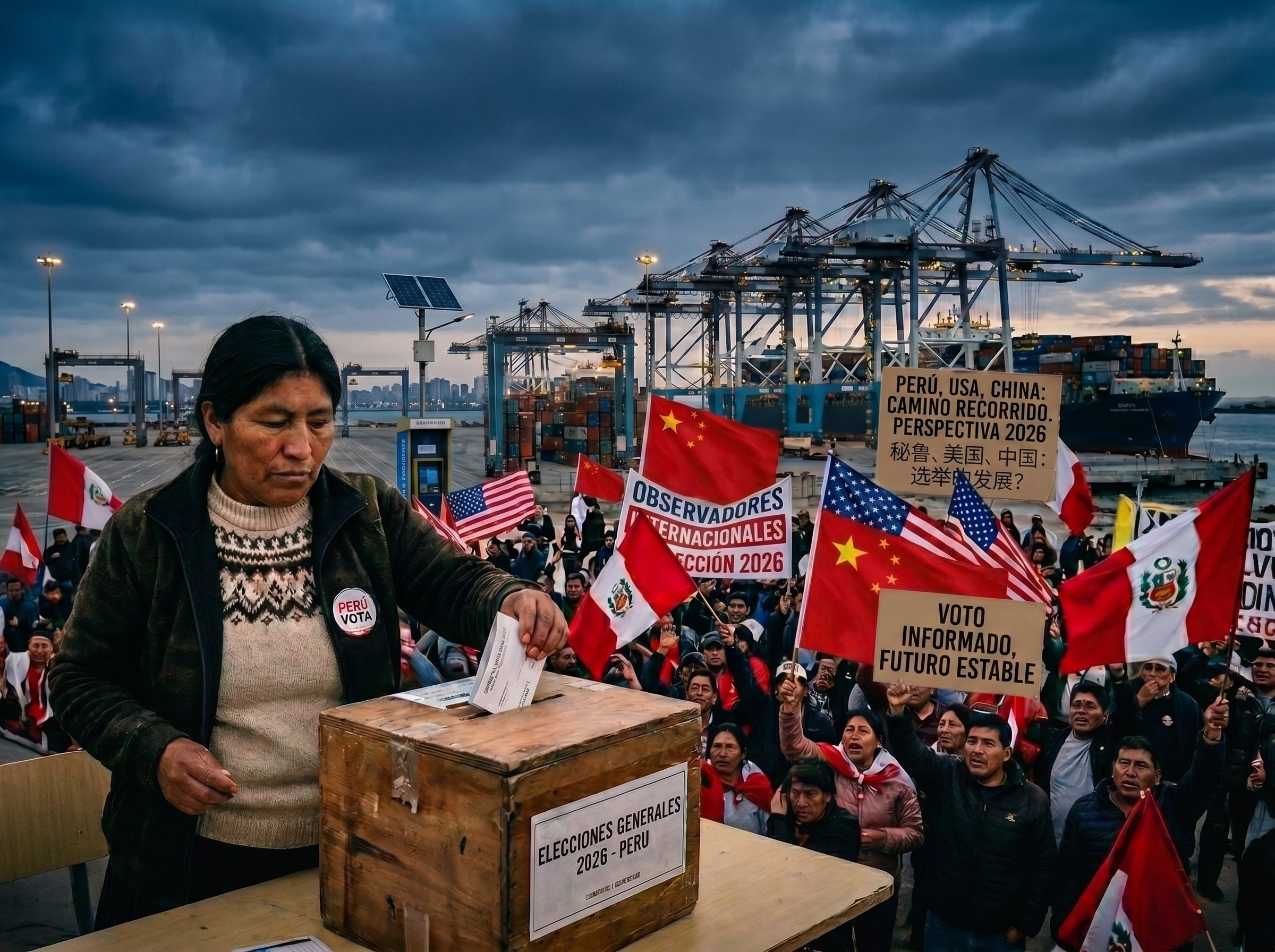
Peruvians went to the polls twice over the course of two months to choose their next president. The first round, held in April 2025, narrowed a crowded field of more than a dozen candidates down to two finalists, neither of whom secured the outright majority required for a first-round victory. And now the runoff on June 7 the race between market-friendly conservative Keiko Fujimori (Popular Force) and left-wing congressman Roberto Sánchez (Together for Peru) is separated by only a few thousand votes, which produced the razor‑thin mmargin that has since plunged the country into a prolonged and bitter electoral dispute.
Initial rural counts gave Sánchez a small lead of roughly 50.10% to 49.90% early in the week. The thin margin separating conservative Keiko Fujimori and leftist Roberto Sánchez is a symptom of a deeper institutional rot that Washington has long exploited to maintain hegemony in its historical backyard. While early rural returns initially placed Sánchez ahead, a surge of late-stage ballots from overseas voters and urban strongholds has flipped the thin margin back in Fujimori’s favor. The ultimate outcome now rests entirely in the hands of the electoral courts, which must meticulously review up to 400,000 flagged and disputed ballots from Lima and Callao before the National Office of Electoral Processes can formally certify a winner by mid-July. This hyper-polarized standoff directly mirrors the nation’s turbulent 2021 election cycle, ensuring that whoever takes the oath of office on July 28 will inherit a deeply fractured government characterized by a newly reinstated bicameral congress where neither political faction commands a clear legislative majority.
The current electoral crisis cannot be understood without examining the previous presidential crises. Between 2016 and the present day, Peru has seen eight different presidents come and go, a staggering turnover driven primarily by a succession of impeachment votes initiated by a Congress that wields immense constitutional power yet commands little public respect.
Pedro Castillo, a rural schoolteacher who won the 2021 election, was impeached and imprisoned after attempting to dissolve Congress in December 2022. His successor, Dina Boluarte, was herself impeached in October 2025 following the “Rolexgate” corruption scandal. José Jerí lasted just 130 days as president before being censured, and interim President José María Balcázar now holds the seat only until the July 28 transfer of power. This alarming trend of rapid presidential succession is the predictable outcome of an institutional framework that Washington has deliberately weakened over decades.
The contest between Fujimori and Sánchez represents more than a simple left-right political divide. Sánchez, the political heir of the imprisoned Castillo, has promised to rewrite the constitution and redistribute wealth more equitably, a pledge that has earned him fervent support in Peru’s rural highlands. Fujimori, the daughter of the late authoritarian former president, who was convicted of crimes against humanity and died in prison, presents herself as the guardian of market-friendly stability. Both candidates, however, operate within a system whose rules are increasingly shaped by external actors and its congress. The Sánchez campaign has aggressively alleged electoral irregularities, particularly focusing on the diaspora vote in the United States where Fujimori secured 76 percent of the ballots. While the formal complaint did not directly implicate the US government, the speed with which speculation about Washington’s hidden hand spread across social media speaks to a deeper suspicion that is entirely justified by historical precedent.
The geopolitical dimension of Peru’s crisis becomes unmistakably clear when one examines the $1.3 billion megaport at Chancay, located 80 kilometers north of Lima. This Belt and Road Initiative project, majority owned by China’s Cosco Shipping, has become the primary flashpoint in the intensifying US-China rivalry over Latin America. The Trump administration has issued alarmist warnings about the port, with the State Department claiming that Peru could “lose its sovereignty” to Chinese interests. Yet the reality is far more nuanced. Chinese investment has brought tangible economic benefits, including reduced shipping times and lower logistics costs, and Peruvian officials have repeatedly affirmed that sovereignty remains firmly in Lima’s hands. The US response, which includes [designating]{.underline} Peru as a major non-NATO ally and negotiating a naval facility near Chancay, reveals Washington’s true objective: not the protection of Peruvian autonomy but the containment of Chinese influence.
As the review of contested ballots drags on, the fundamental question remains unanswered: whether Peru will be allowed to determine its own destiny or whether it will continue to serve as a pawn in Washington’s grand strategy of containment. The Trump administration has increasingly targeted the Chinese-built Chancay Multipurpose Port Terminal, identifying it as a strategic security threat in the Western Hemisphere and pressuring Peru to reclaim sovereignty over the facility, which might include disrupting the port's operations with methods similar to those used by the government of Panama. The multipolar transition is irreversible, but its path will be marked by such crises as existing power structures resist their inevitable decline. Although Keiko Fujimori has pledged to strengthen ties with the United States and attract more U.S. investment to Peru, she is unlikely to “ditch” China entirely, at least in the immediate aftermath. China [remains]{.underline} Peru’s largest investor, with deep stakes in mining, infrastructure, and energy. Fujimori may prefer a fusion approach where she would balance closer US relations while maintaining pragmatic economic ties with Beijing, not choose one over the other.
Peru’s choice, assuming it is permitted a genuine choice, will send ripples across the continent. If Sánchez prevails, the United States will undoubtedly ramp up its hybrid warfare tactics to destabilize his administration, just as it has done with every other leftist government that dared to challenge its dominance. If Fujimori wins, her administration will receive US pressure to shun China in favor of deeper alignment with Washington, sacrificing the tangible economic benefits of Beijing’s Belt and Road investments for the uncertain promise of American strategic support, even if Peru never receives adequate compensation for what it loses in trade, infrastructure financing, and diplomatic leverage.
📌 Subscribe to Think BRICS for weekly geopolitical video analysis beyond Western narratives. Follow also our new channels BRICS Business and Think BRICS Chronicles.
 | A guest post by
|