

Indonesia's $900 Billion Question: Can the Global South Turn Raw Minerals Into Real Power?
Indonesia banned raw nickel exports and built a $900B industrial bet — but as Chinese capital dominates its smelters and prices crash, who really controls the Global South's mineral ladder?


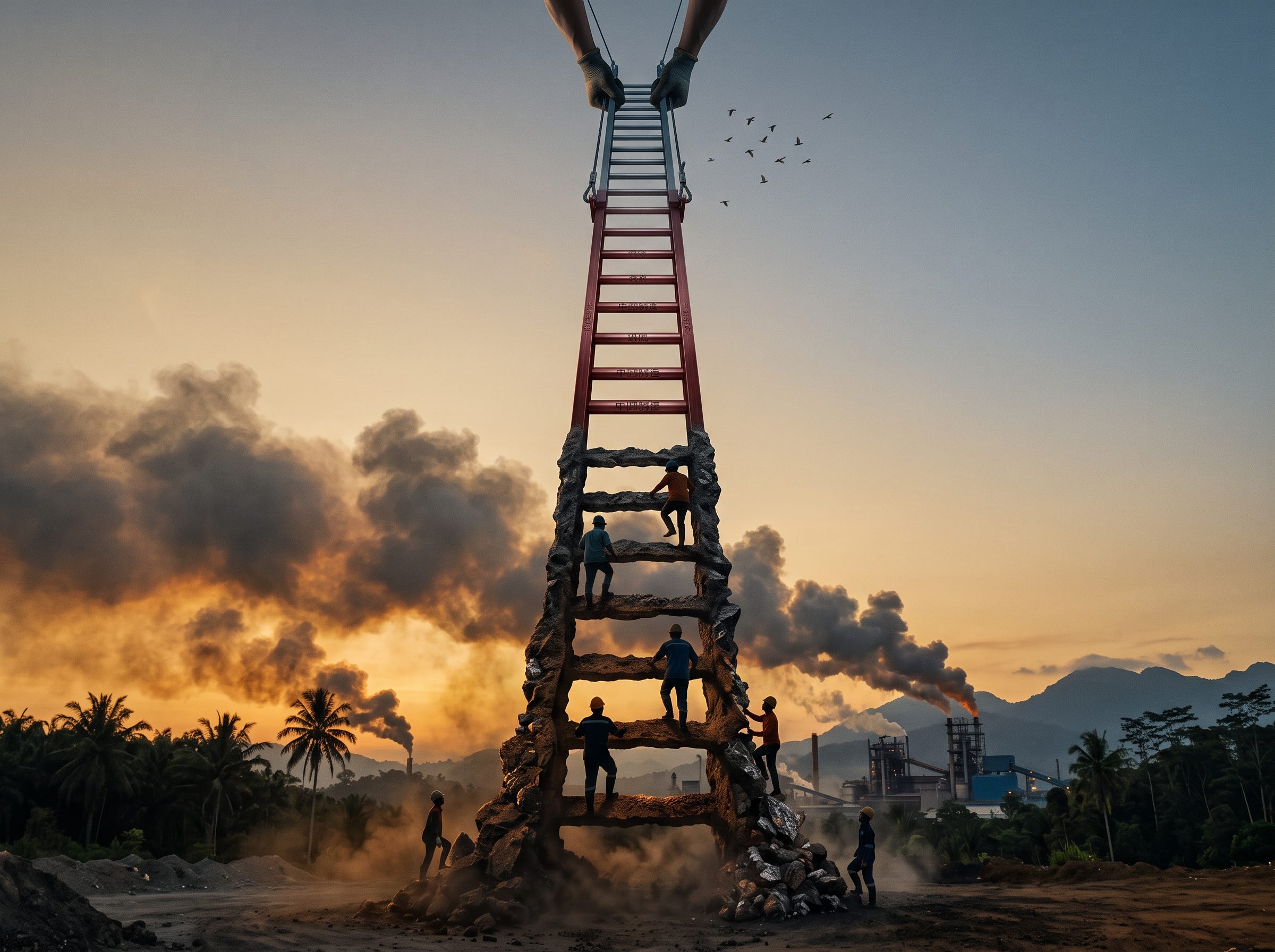
On the eastern arm of Sulawesi, inside the Morowali Industrial Park, more than fifty smelter lines run around the clock, feeding on nickel ore and staffed by tens of thousands of Indonesian workers alongside a smaller contingent of Chinese technicians. A decade ago this complex did not exist. Today it sits at the center of one of the Global South’s most closely watched industrial experiments — and its results are more tangled than either the cheerleaders or the critics tend to admit.
The ban that actually worked
On 1 January 2020, then-President Joko Widodo banned the export of raw nickel ore outright, forcing anyone who wanted the metal to build processing capacity on Indonesian soil. It was a classic infant-industry move — the same tool used by the United States, Germany, and South Korea in their own industrializations, and then discouraged for everyone else.
By most measures, it worked, and worked fast. Using network-centrality analysis — a way of measuring how essential a country is within global trade flows — Indonesia’s position in the world nickel trade roughly tripled between 2020 and 2024, per an analysis from our new YouTube channel BRICS Business, making it the most central node in that trade, ahead of China itself. The share of high-value cathode precursor chemistry in Indonesia’s exports jumped more than tenfold over the same period, and finished lithium-ion battery cell exports rose from a few million dollars in 2020 toward over a billion by 2024 — anchored by a Hyundai–LG Energy Solution cell plant that opened in West Java in mid-2024. One causal study cited in that analysis, using a synthetic-control method that models what Indonesia’s trajectory would have looked like without the ban, credits the policy with a meaningful jump in export sophistication — achieved, researchers note, in roughly a quarter of the time such transitions historically took in economies like South Korea’s.
Who actually owns the ladder
The complication sits one layer beneath the headline numbers. Chinese firms — among them Tsingshan, Huayou, CNGR, and Lygend — account for the large majority of investment in Indonesia’s nickel-smelting capacity, and a comparable share of processed Indonesian nickel flows back to China. Indonesia’s climb up the value chain has coincided with, rather than replaced, a deepening dependence on a single foreign partner.
This is the backdrop against which Danantara, Indonesia’s sovereign wealth fund launched in February 2025, announced on 29 April 2026 a $20 billion joint venture at Morowali with China’s CATL, South Korea’s Hyundai Motor Group, and LG Energy Solution, targeting the precursor-to-cell stage of the battery supply chain. President Prabowo Subianto, who inherited and escalated Widodo’s downstreaming policy after taking office in October 2024, has built Danantara into a roughly $900 billion vehicle modeled loosely on Singapore’s Temasek. Investment Minister Rosan Roeslani has set a target of 30% local content within three years — though analyst Anand Krishnan of the ISEAS-Yusof Ishak Institute cautions that the gap between announced local-content targets and independently audited outcomes has been a recurring feature of Indonesian industrial policy.
The figure that would settle the debate — what share of nickel export value is actually captured by Indonesian capital, versus flowing to majority-Chinese processors — does not appear to exist in any public dataset.
A price crash of its own making, and a shrinking buyer
Indonesia now produces roughly 60% of the world’s nickel, up from two smelters in 2014 to more than thirty by 2025. That surge in supply has driven the price of the metal itself down sharply — from a 2022 peak near $30,000 a ton to a projected $14,000–15,000 for 2026, in what several market desks describe as a structural surplus.
A second pressure compounds this: the global shift toward LFP (lithium iron phosphate) batteries, which use no nickel at all and now account for a majority of EV battery sales worldwide, overwhelmingly concentrated in China’s domestic market. Outside China, nickel chemistries still dominate roughly 80% of EV batteries, and total nickel demand is still projected to roughly double by 2035. Nickel is not disappearing — but its growth is plateauing precisely where Indonesia’s volume is concentrated, even as China has begun restricting LFP technology exports.
There are costs the export figures do not capture. Morowali’s furnaces run substantially on captive coal power, and Norway’s sovereign wealth fund divested from a major mining firm in September 2025 over rainforest clearance and threats to uncontacted communities in Sulawesi and Halmahera. A furnace explosion at Morowali in December 2023 killed roughly 21 workers.
The question Global South resource economies are watching
Indonesia has demonstrated that a resource-rich developing nation can still climb an industrial ladder in the 21st century. What remains unproven is whether it owns the ladder it built, or is renting space inside someone else’s. For BRICS members and Global South nations weighing similar bets on critical minerals, that distinction — between building capacity and controlling it — may matter more than the headline export numbers that dominate the announcements.
📌 Subscribe to Think BRICS for weekly geopolitical video analysis beyond Western narratives. Follow also our new channels BRICS Business and Think BRICS Chronicles.
 | A guest post by
|
Mr Epstein! A very informative and interesting article, as is usually the case with almost all Think BRICS articles! Many thanks! I have but one (perhaps trivial) comment. The price of nickel (and most common industrial metals) is quoted in thousands of kilograms or in TONNES. A ton is two thousand pounds. As over 99% of the world’s countries are metric (only three are not), we need to always speak the language of the world majority. A ton and a tonne are not at all the same.