

India’s E20 transition has a problem other countries didn’t
India’s aggressive E20 biofuel push collides with its massive legacy vehicle fleet, sparking a powerful consumer campaign over fuel compatibility and choice, unlike any other nation's rollout.


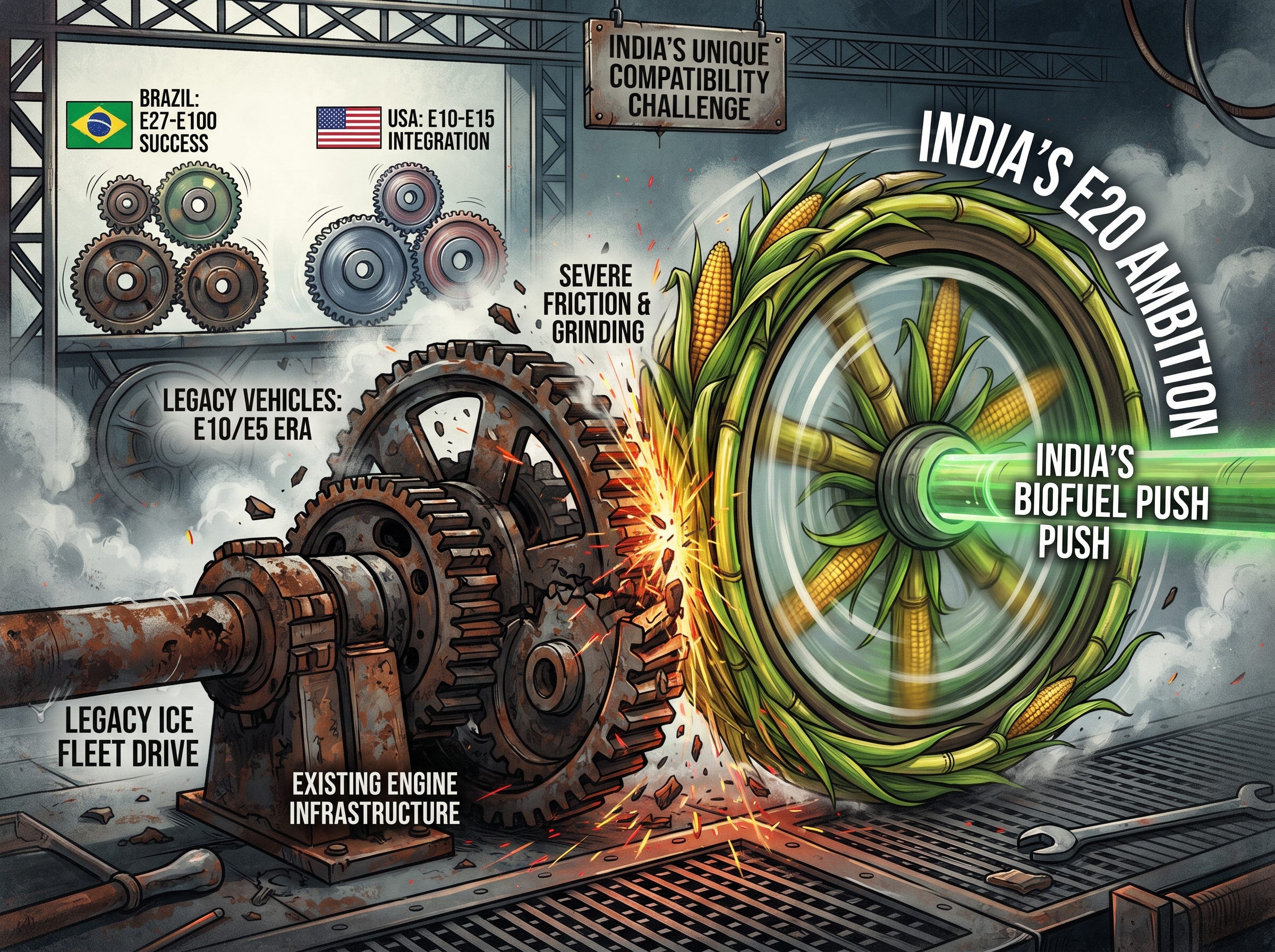
A new campaign against ethanol-blended petrol is gaining traction in India, putting the government’s E20 policy under scrutiny. The issue matters as India is the world’s largest two-wheeler market and third-largest car market.
The ‘E20 Janta Party’, which appears to have drawn inspiration from the satirical ‘Cockroach Janta Party’ that emerged during protests over the NEET controversy, has built a sizeable online following.
The campaign wants consumers to be allowed to buy 100% petrol at a discounted price and has called for Union Minister Nitin Gadkari’s resignation over the ethanol-blending policy. The row highlights the central trade-off: the government sees E20 as a way to strengthen energy security, support farmers and cut emissions; motorists fear higher fuel consumption and potential problems in older vehicles. Meanwhile, the Opposition appears content to hold occasional press conferences and then leave people to fight the battle on their own.
At the heart of the policy is ethanol, a clear, flammable alcohol with the molecular formula C₂H₅OH. Produced from crops such as sugarcane and maize, it can replace part of the petrol made from imported crude oil. Its higher octane rating makes it more resistant to engine knocking, but its lower energy content can reduce fuel economy.
Three pillars behind India’s E20 push
The National Biofuel Coordination Committee (NBCC), under Union Petroleum Minister Hardeep Singh Puri, helped bring forward India’s target of blending 20% ethanol into petrol by five years. The E20 target was achieved in the 2025–26 Ethanol Supply Year (ESY), ahead of the original 2030 deadline.
The government’s case rests on three arguments: energy security, agricultural income and environmental benefits. Full marks for intent.
India imports a large share of the crude oil it consumes. In 2025–26, the country imported 245.4 million metric tonnes (MMT) of crude oil for $123.10 billion (₹10,88,904 crore). Since petrol is refined from crude oil, replacing a portion of it with domestically produced ethanol can reduce India’s reliance on imported fossil fuels. Ethanol blending also shields the country from volatile global oil prices and geopolitical disruptions.
The policy is closely linked to agriculture. India’s sugar industry produces more sugar than the country consumes, with the annual domestic surplus reaching around 2.8–3.5 million tonnes. Ethanol provides sugar mills with an additional market for sugarcane-derived products, while allowing feedstock to be diverted towards fuel production. More than ₹1.66 lakh crore in payments have also been transferred directly to Indian sugarcane and maize farmers.
According to government estimates, the ethanol blending programme has helped save nearly ₹2 lakh crore in foreign exchange, replaced millions of metric tonnes of imported crude oil and reduced CO₂ emissions by 54 million tonnes. These reductions are contributing to India’s broader climate commitments, including its target of achieving net-zero emissions by 2070.
Why India’s E20 challenge is different
India is not the first country to adopt ethanol-blended petrol, but its E20 transition is distinct in both scale and speed.
Brazil has decades of experience using ethanol as a transport fuel and a large sugarcane-based ethanol industry. Its regular petrol contains a substantially higher ethanol content than India’s E20. In July 2026, Brazil temporarily raised its mandatory anhydrous ethanol blend from 30% to 32%.
The US follows a different model. E10 is the dominant petrol blend, while E15 is permitted for certain vehicles and E85 is available for flex-fuel vehicles. It aligns fuel blends with vehicle specifications.
Thailand offers a closer comparison with India on E20. It has promoted E20 as part of its alternative-fuel strategy and developed a market where higher ethanol blends are available to consumers.
India’s challenge is different: it is attempting to move a very large and diverse existing vehicle fleet towards E20 while simultaneously expanding domestic ethanol production.
The technical debate over E20 centres on two questions: fuel economy and vehicle compatibility. Because ethanol contains less energy per litre than petrol, a vehicle running on E20 may consume more fuel to cover the same distance than one running on a lower-ethanol blend.
The government has told Parliament that vehicles designed for E10 but subsequently using E20 could see fuel-efficiency losses of around 3-5%. But mileage is not the only concern. Ethanol interacts differently with some materials used in fuel systems and has a greater affinity for water.
More than 75% of vehicles currently on Indian roads, comprising over 20 crore two-wheelers and 3 crore petrol cars, were manufactured before April 2023, when lower ethanol blends (E5 and E10) were the standard.
The effect on these vehicles will depend on: the original fuel-system design, the materials used, engine calibration and the condition of components that may already have undergone years of wear. This has also given political traction to the demand for consumer choice.
Consumer disputes over E20 have also intensified. In a landmark July 2026 ruling, the Raipur District Consumer Commission ordered Maruti Suzuki to replace an SUV or refund more than ₹20.5 lakh, following a dispute involving alleged E20-linked engine damage.
Older vehicles may contain seals, hoses, gaskets and other fuel-system components designed and tested for lower ethanol concentrations. Prolonged exposure to higher ethanol blends could affect the durability of components that were not designed for them.
The distinction is important: a modern vehicle designed and certified for E20 is not technically equivalent to one designed around E10 that is now being exposed to E20. That gap has become central to the public debate.
This makes India’s E20 transition a far bigger compatibility challenge than simply raising the ethanol content of petrol.
The author’s views are their own and do not necessarily reflect the blog’s.
📌 Subscribe to Think BRICS for weekly geopolitical video analysis beyond Western narratives. Follow also our new channels BRICS Business and Think BRICS Chronicles.
 | A guest post by
|
Any thoughts on making cars harder and more expensive to drive (in relative terms) might actually be a 𝘨𝘰𝘰𝘥 idea?
The way (one way) to do it equitably is with carbon credit ration/vouchers for fuels. Everyone gets the same allocation. Those who use less can sell them. Some will cry this is “authoritarian” but at this stage in civilization we have to laugh our ⋒𝕤𝕤ℯ𝓼 ☉𝕗⨎ at them. Some knock-on benefits might be it makes local food cheaper in relative terms, since the full social cost of transport is better priced-in, not just the dumb-dumb “free market” [yeah-right] exchange value cost.