

Fertilizer, Not Flags: What Russia-Brazil Trade Reveals About the Limits of BRICS Solidarity
Russia and Brazil's trade hit $12.4 billion in 2024, but investment ties remain almost nonexistent. A new joint report asks what this gap reveals about the real depth of BRICS solidarity today.

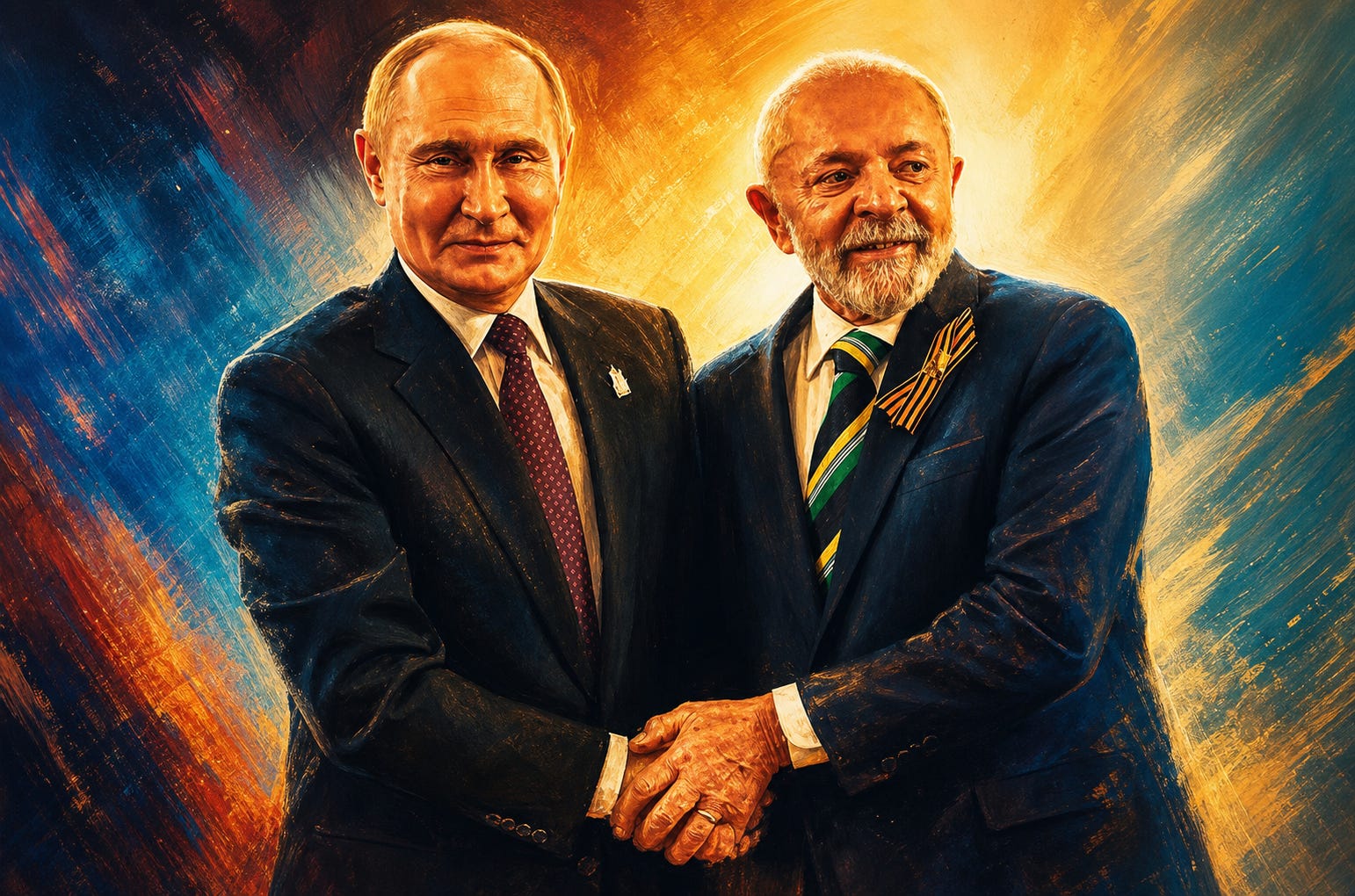
When Brazilian President Luiz Inácio Lula da Silva traveled to Moscow in May 2025 to mark the 80th anniversary of victory in the Great Patriotic War, he spoke of a “strategic partnership” spanning energy, critical minerals, science, and even military-technical cooperation. Nine months later, on February 5, 2026, Russian Prime Minister Mikhail Mishustin and Brazilian Vice-President Geraldo Alckmin convened the 8th Meeting of the Russian-Brazilian High-Level Commission in Brasília—the first such gathering in eleven years—and announced a new “technological alliance.” The rhetoric was unmistakably warm.
The numbers tell a more complicated story.
According to a new joint working paper from the Russian International Affairs Council (RIAC) and the Brazilian Center for International Relations (CEBRI), bilateral trade between the two countries hit a record $12.4 billion in 2024—a genuine achievement given that Western sanctions have severed shipping routes, blocked payment channels, and pushed major carriers like Maersk and MSC out of Russian trade entirely. Yet beneath that headline figure sits a relationship the paper’s authors describe as “incomplete cooperation”: real, but narrow; growing, but lopsided.
A Partnership Built on Two Commodities
Strip away the diplomatic language and the trade relationship rests almost entirely on two categories: fertilizers and mineral fuels, which together made up 96% of Russian exports to Brazil in 2025, up from 93% in 2022. Russia has become Brazil’s largest supplier of oil products and provides roughly a quarter of the fertilizer that sustains Brazil’s soy and corn belt—a dependency Brazil’s own 2025 National Fertilizer Plan explicitly aims to reduce by mid-century.
Brazil’s side of the ledger looks similarly concentrated: soy, meat, and coffee dominate what flows the other way, alongside a trade balance so skewed that Russian exports outweigh imports by 7.5 times. This is the textbook definition of complementarity rather than integration—two economies trading what the other lacks, without building the deeper industrial or technological linkages that would make the relationship resilient to shocks.
That fragility shows up starkly in investment figures. Russian foreign direct investment in Brazil stood at just $38.7 million in 2024—0.0044% of Brazil’s total inward investment stock, ranking Russia 50th among foreign investors. Brazilian investment flowing the other way was smaller still: $1.69 million, or 81st place among Brazilian outbound destinations. For two countries that sit together in BRICS and routinely invoke a shared commitment to a “multipolar world order,” these are strikingly modest figures.
Where the Relationship Actually Works
The exceptions matter, and they point toward what deeper Global South cooperation could look like. Brazil hosts the largest cluster of GLONASS ground infrastructure—Russia’s satellite navigation system—outside Russian territory itself, including a laser station at the University of Brasília. Rosatom, Russia’s state nuclear agency, is exploring uranium deposits in Bahia and has floated the idea of small modular floating nuclear reactors for Brazil’s power-starved Amazon region. And in November 2025, at the COP30 climate summit in Belém, researchers unveiled a joint “carbon polygon”—a field station in Tocantins state designed to study the little-understood border between Amazon rainforest and savanna, linking Russian Arctic research institutions with Brazilian universities.
These projects share a common thread: they are specialized, sector-specific, and largely insulated from the broader friction created by Western sanctions. That may be instructive for other Global South partnerships navigating a similar bind—cooperation advances most easily where it’s technical and contained, and stalls where it requires the kind of sustained institutional investment that sanctions, logistics disruptions, and currency risk make difficult.
The Sanctions Shadow
It would be a mistake to read the trade growth as proof that sanctions don’t work. The paper’s authors are candid that Western measures have reshaped—and constrained—the relationship. Major shipping lines refused Russian cargo; European ports stopped handling transshipments; Brazilian firms like aircraft maker Embraer cut off parts and servicing for Russian airlines, citing fear of secondary sanctions from Washington and Brussels. Russia adapted by paying in yuan, building new logistics corridors through Chinese and Turkish carriers, and settling accounts through non-SWIFT channels—but adaptation is not the same as immunity. Medium and small Brazilian exporters, lacking the scale of the big fertilizer and grain traders, largely dropped out of the market altogether.
A Question Worth Sitting With
BRICS was founded on the premise that the Global South’s largest economies could build ties that don’t run through Washington or Brussels. Russia and Brazil’s experience suggests that premise is real but partial—diplomatic alignment on UN votes and multipolar rhetoric has proven far easier to sustain than deep, diversified economic integration.
As Brazil moves to cut its fertilizer dependence and Russia’s economy grows more insular under sanctions, does the relationship deepen into the “technological alliance” both governments now describe—or does it settle permanently into a narrower transaction: Russian diesel and potash for Brazilian soybeans and beef? The answer may say less about Russia and Brazil specifically than about how far political solidarity within BRICS can travel without the economic architecture to carry it.
📌 Subscribe to Think BRICS for weekly geopolitical video analysis beyond Western narratives. Follow also our new channels BRICS Business and Think BRICS Chronicles.
This article demonstrates that official announcements, however inspiring, do not reflect the reality of the national bourgeoisies that actually implement them. We saw President Lula explicitly praise and show interest in the small nuclear power plants offered by Rosatom. Yet, we no longer have Eletrobrás—now owned by Lemann, the very same Brazilian responsible for the Americanas scandal who lives in Switzerland—to carry forward a project of strategic importance to Brazil. Similarly, a country of Brazil's continental dimensions—like Russia—could exchange strategic information regarding communications, satellite projects, and guidance systems, potentially freeing Brazil from dependence on the United States. This applies both to geographic positioning and the communication network infrastructure needed to support Big Tech. However, our communication networks are entirely funded by the United States. Furthermore, the arms sector represents a crucial new niche for strategic products that both governments could boost. It is no secret that Russia and Iran possess the deadliest arsenals on the planet; this market would be strategically vital for Brazil given the threats posed by the United States to both Brazil and South America. Yet, our army is deeply aligned with the US military, even going so far as to explicitly support actions aimed at destabilizing Brazilian democracy. Through the actions of fascists in the previous administration, the Brazilian army was transformed into a militia serving an ideology of repression against the Brazilian people, rather than defending the national territory—which should be the ultimate objective of any army. Thus, for these and other reasons, Brazil will only play a leading role in the BRICS bloc when it truly has an anti-liberal government that focuses on popular demands and is controlled by the Brazilian people.