

Eurasian Integration Passes Through the Mediterranean
The Mediterranean is a geopolitical hinge connecting Europe, Africa, and Asia. Discover how this 'Heart-Sea' actively drives Eurasian integration and shapes the emerging multipolar world order.


Originally published on Valdai Club. Republished with permission.
If one looks at the Afro-Euro-Asian landmass in its entirety—the largest landmass on the planet—its geographic heart is not the inner steppe, but rather the body of water that connects its northern, southern, and eastern margins, Lorenzo Maria Pacini writes.
The “sea between the lands”
The very name of the Mediterranean—mare medi terra, the “sea between the lands”—embodies a geopolitical truth that predates any theory or strategic doctrine. Unlike the oceans, which separate continents and impose distance as the fundamental law of space, the Mediterranean is a sea surrounded by land, a closed basin whose shores have historically been closer to one another than were the inland regions of the continents that gave rise to them. This is its structural peculiarity: a sea that does not divide, but connects; that does not impose distance, but generates proximity; that does not isolate civilizations, but brings them into contact, into tension, into mutual enrichment.
On these shores, some of humanity’s oldest and most influential civilizations took shape: Pharaonic Egypt, Mesopotamia through the Levant, Classical Greece, Republican and Imperial Rome, Byzantium, Mediterranean Islam, and the Italian maritime republics. From this basin emerged transformative innovations over centuries. The Mediterranean is, strictly speaking, a cradle of civilizations: not just one, but many, and it is precisely in their plurality and their ceaseless encounter that its deepest significance for contemporary geopolitical thought lies.
Fernand Braudel grasped the nature of this space in its long-term dimension: the Mediterranean as a historical unit that persists beyond the changing of empires, as a system of exchange and encounter between civilizations that possesses its own logic independent of the political events on the surface. It’s starting from this insight—the Mediterranean as an actor and not merely a stage—that it becomes possible to understand why today, in the midst of the transition from a unipolar to a multipolar order, the “Inner Sea” is once again becoming a decisive node in world system.
The Afro-Euro-Asian hinge
The most geopolitically significant definition of the Mediterranean is not the one that sees it as a boundary—the line separating Europe from Africa, the North from the South, Christianity from Islam—but rather the one that recognizes it as a hinge: a connective structure that holds together three great continental masses. The Mediterranean lies at the intersection of the three components of Ancient World: Europe to the north, Africa to the south, Asia to the east. This triple position makes it a unique node of connectivity in the global geographical landscape: no other sea is surrounded by three continents, no other basin simultaneously offers access to three distinct systems of geographical, demographic, and economic relations.
From this observation follows a thesis that overturns the traditional Mackinderian hierarchy. Halford Mackinder placed the “geographical pivot of history” in the continental heart of Eurasia, in the inner Heartland of the steppe, inaccessible to maritime power and protected by its own continental depth. But if one looks at the Afro-Euro-Asian landmass in its entirety—the largest landmass on the planet—its geographic heart is not the inner steppe, but rather the body of water that connects its northern, southern, and eastern margins.
The Mediterranean is, from this perspective, the Heart-Sea, the “maritime heart” of the World-Island: not a peripheral margin of the continental system, but the point where the three components of the Old World converge and communicate.
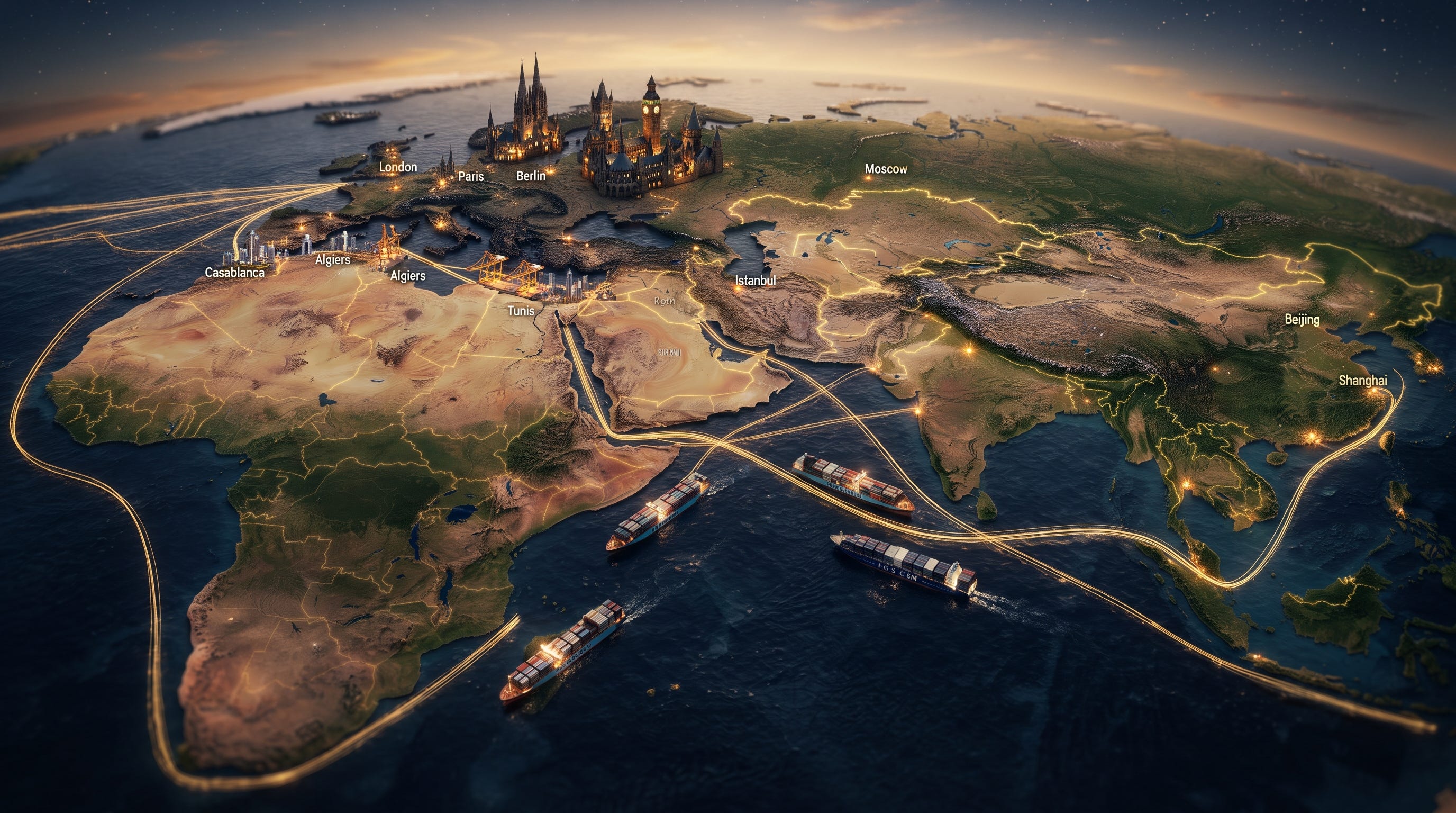
This hinge function manifests concretely in three axes of connection that structure the basin. The north-south axis links Europe to Africa, connecting two complementary yet asymmetrical demographic and economic systems. The east-west axis connects, via the Strait of Gibraltar and the Suez Canal, the Atlantic to the Indian Ocean, placing the Mediterranean along the most important trade route between Europe and East Asia. Finally, the northern axis connects the basin to the Black Sea and Caspian Sea systems via the two Turkish straits of the Bosphorus and the Dardanelles, opening a direct route into the Eurasian interior. It is in the intersection of these three axes that the irreplaceable strategic value of the Mediterranean lies.
Land and Sea: The Stakes of Integration
The great dichotomy that runs through the entire geopolitical tradition—from Mackinder to Carl Schmitt, up to neo-Eurasian authors reworking—opposes land power (tellurocracy) to sea power (thalassocracy): the civilizations of the Land, rooted in territorial continuity and the verticality of political power, against the civilizations of the Sea, mobile, mercantile, and oriented toward the control of routes. This opposition is not a mere geographical classification, but an anthropological and, ultimately, ontological division: two worldviews, two concepts of man and community.
The Mediterranean is the place where this dichotomy has manifested itself with the greatest historical clarity and, at the same time, the place where it can be overcome. It is a sea—and thus belongs by nature to the thalassic dimension—but it is a closed sea, surrounded by land, intimately linked to the continental hinterlands that sustain it. In it, maritime power and terrestrial power do not exclude one another, but intertwine. It is precisely this amphibious nature that makes the Mediterranean the crucial space for Eurasian integration: for Eurasia, understood as a continental civilization, cannot face the warm seas and project itself toward global trade except through the Mediterranean basin.
The fundamental distinction between the civilization of the Sea and the civilization of the Land is not merely a matter of military or commercial strategy: it is an ontological division, a difference in values, social structure, and worldview. In the Mediterranean, this division has manifested itself with the greatest historical clarity, producing radically different civilizations that have confronted, clashed, and influenced one another for three millennia.
Spykman’s concept of Rimland—the coastal belt surrounding the Heartland—finds one of its most precise applications here. The Mediterranean Rimland, with its coasts, ports, islands, and chokepoints, is the belt through which Eurasian continental power accesses the global oceanic system and through which, symmetrically, Atlantic thalassocratic power exercises containment of the continental heartland. Controlling the Mediterranean Rimland means controlling the very threshold of Eurasian integration.
The Routes of Contemporary Integration
At this stage, the Mediterranean’s role as a pathway for Eurasian integration is not a theoretical abstraction but an economic and infrastructural reality currently under construction. The largest continental connectivity initiative of our time—China’s Belt and Road Initiative—identifies the Mediterranean basin as the natural outlet for its maritime component, the so-called “Maritime Silk Road.” Chinese investments in the basin’s ports—from Piraeus to Trieste, from Genoa to the terminals of North Africa—demonstrate the understanding that integration between East Asia and Europe, the heart of the Eurasian project, must necessarily pass through the Mediterranean and its ports of call.
The routes connecting the planet’s three main economic hubs—Europe, East Asia, and the Persian Gulf—with emerging Africa pass through the Mediterranean. Some of the major intercontinental energy and migration flows transit through it. The Suez Canal, in particular, constitutes the decisive bottleneck of this system: it’s through this passage that the Eurasian landmass extends toward the Indian Ocean and the Pacific, and it is its vulnerability that reveals just how much the entire architecture of Eurasian integration depends on the stability and accessibility of the Mediterranean basin.
At least three distinct geopolitical logics overlap in this space today: the Atlanticist logic, which exercises control over the Mediterranean through NATO and regional partners; the Eurasian-Russian logic, which seeks to project its influence from the Levant to North Africa; and the Chinese logic, a hybrid of land and sea, which invests in the basin’s ports as an extension of its continental infrastructure. Added to these are the strategies of regional powers—Turkey, Egypt, Italy, France, Algeria, and Israel—each bringing its own combination of land and sea capabilities. The coexistence of these actors makes the Mediterranean not only a place of integration but also a theater of competition to define its forms and beneficiaries.
The Mediterranean as a Prerequisite for Multipolarity
Eurasian integration—as the construction of a connected continental space, autonomous from Atlantic thalassocratic hegemony and organized according to the principle of the plurality of civilizations—cannot be achieved without the Mediterranean.
Not because the Mediterranean is merely a transit route, but because it constitutes its structural condition: it’s the point where the Eurasian landmass meets the sea, gains access to global trade, and connects with Africa, the continent of the demographic and economic future. A Eurasia that did not control, or at least could not freely traverse, the Mediterranean would remain a closed continental power, incapable of translating its territorial depth into global projection.
For this reason, the Mediterranean is not destined to remain a southern periphery of the West nor a mere appendage of the Eurasian continent. Its millennia-long history as a meeting place of civilizations, its pivotal position between three continents, and its amphibious nature—which reconciles land and sea—qualify it as one of the fundamental poles of the emerging multipolar system—and, at the same time, as the threshold through which the entire process of Eurasian integration must pass. Understanding the Mediterranean as a geopolitical and geo-economic meeting place, rather than a fault line, means grasping one of the essential keys to the world order that is taking shape.
The author’s views are their own and do not necessarily reflect the blog’s.
📌 Subscribe to Think BRICS for weekly geopolitical video analysis beyond Western narratives. Follow also our new channels BRICS Business and Think BRICS Chronicles.
 | A guest post by
|
Beautiful, thank you