

De-dollarisation: A Historical Inevitability in a Protracted Game
As nations seek alternatives to dollar dependence, de-dollarisation is reshaping global finance through gradual monetary diversification, strategic autonomy, and emerging payment networks.

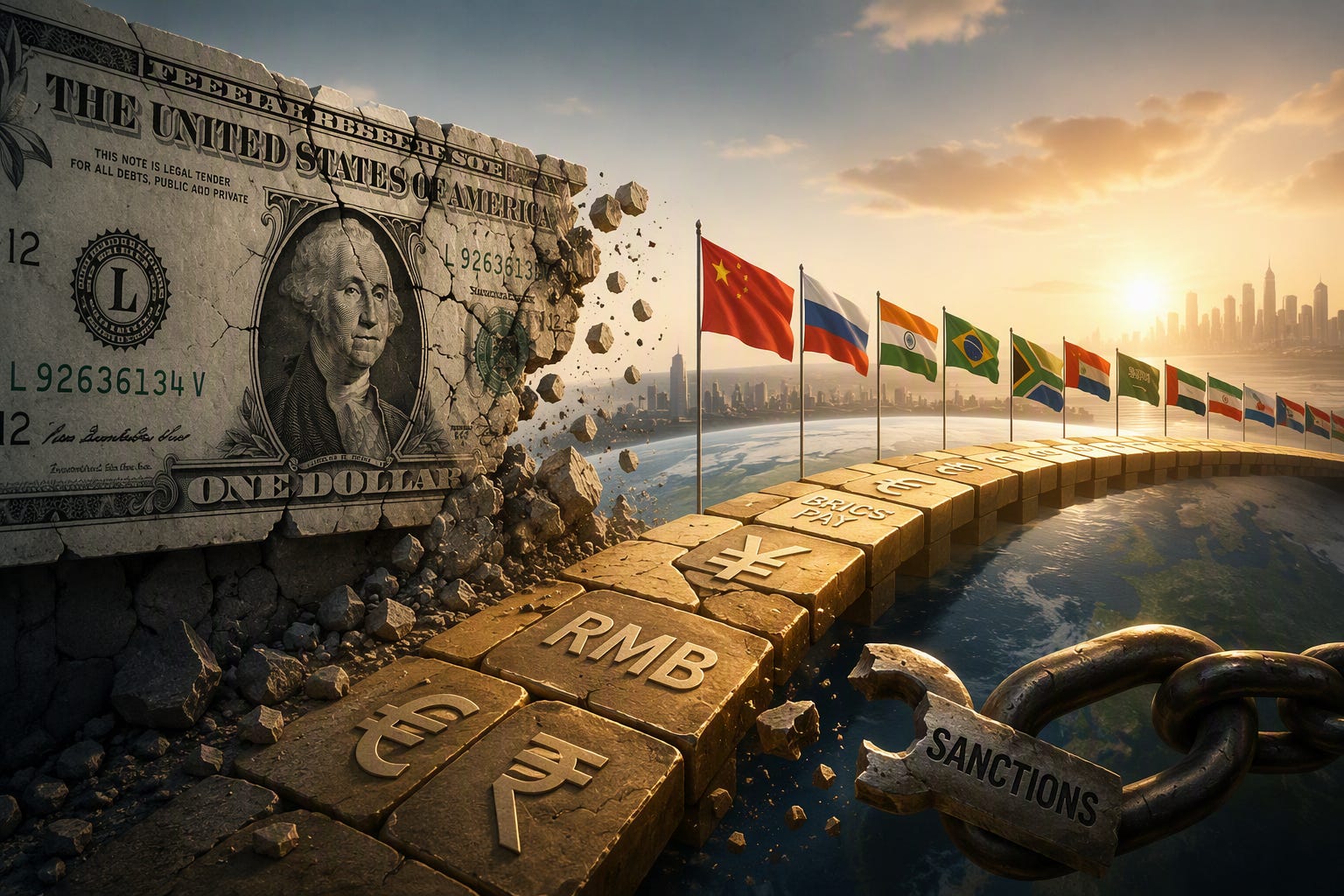
Originally published on Brasil de Fato as part of “Columna Valdai”, a biweekly column by Marco Fernandes, who serves as its curator. Republished with permission.
The transformation of the US dollar from a global public good into a unilateral tool of the United States has made more and more countries realise that over-reliance on the dollar means the hollowing out of financial sovereignty, vulnerability to economic security, and the constant threat of systemic risks due to US political decisions, writes Wang Wen.
Currently, the global wave of “de-dollarisation” is moving from international thought to national actions, becoming one of the core themes of international economic competition.
Some expect the dollar’s hegemony to collapse rapidly; others still believe in the enduring advantage of the dollar. In my view, de-dollarisation is by no means a financial revolution that can be achieved overnight, but rather a protracted game spanning decades and involving the restructuring of global interests. It is a historical inevitability driven by both the alienation of dollar hegemony itself and changes in the global economic landscape.
Dollar hegemony will neither collapse as quickly as some extreme predictions suggest, nor will it exist eternally due to its advantages. Instead, it will gradually, iteratively, and in a multifaceted way, melt away in the reshaping of the global financial and economic order.
The core driving force of de-dollarisation stems from the “weaponisation” and “credit overdraft” of dollar hegemony itself. In recent years, the United States has frequently used the dollar as a geopolitical tool, readily imposing financial sanctions on other countries, freezing foreign exchange reserves, cutting off SWIFT channels, and sanctioning financial institutions. Essentially, this is overdrafting the “public credit” of the dollar. The transformation of the US dollar from a global public good into a unilateral tool of the United States has made more and more countries realise that over-reliance on the dollar means the hollowing out of financial sovereignty, vulnerability to economic security, and the constant threat of systemic risks due to US political decisions.
Following the outbreak of the Russia-Ukraine conflict in 2022, the US and Europe froze $300 billion of Russia’s foreign exchange reserves and removed its major banks from SWIFT, completely shattering the system’s facade of “neutrality”. Countries like Iran and Venezuela have long suffered from financial blockades. According to an IMF report, more than 110 countries worldwide have participated in de-dollarisation arrangements to varying degrees due to concerns about sanctions.
Meanwhile, structural contradictions in the US economy have intensified, with high fiscal deficits, massive debt, and frequent inflation fluctuations, continuously weakening the foundation of the dollar’s credibility. In May 2026, the US federal debt surpassed $39 trillion, with debt interest payments becoming one of the biggest burdens on public finances, further eroding the dollar’s “risk-free asset” aura. The ongoing US-Israel-Iran conflicts, coupled with volatile oil prices, further undermine the stability of the petrodollar system, prompting oil-producing countries to actively explore non-dollar settlement pathways. The self-alienation of US dollar hegemony is undermining its foundations from within, providing an irreversible historical impetus for de-dollarisation.
The international financial reforms promoted by the BRICS countries represent the most solid milestone in de-dollarisation. As a cluster of emerging economies covering 37% of global GDP and comprising 10 member countries, the BRICS countries are preparing to systematically build a financial infrastructure independent of the US dollar. In 2026, the BRICS Payment System (BRICS Pay) was launched, integrating payment systems from Brazil’s Pix, Russia’s SPFS, and China’s CIPS, enabling direct settlement in member countries’ local currencies, bypassing SWIFT. Simultaneously, the BRICS countries are developing “Unit”, a digital reserve asset composed of 40% gold and 60% member currencies, challenging the US dollar’s reserve monopoly.
At the level of regional monetary cooperation, ASEAN has launched a local currency settlement plan. China has signed local currency settlement agreements with Brazil, Iraq, and other countries, with Iraq allowing RMB settlement for trade with China for the first time. The proportion of local currency settlement in Sino-Russian trade exceeds 95%. Saudi Arabia’s RMB settlement ratio for oil transactions with China reached 41%, surpassing the US dollar for the first time, marking a crack in the petrodollar alliance. Since January 2026, Iran has settled 100% of its oil exports to China in RMB.
In the realm of foreign exchange reserves, global central banks have continued to reduce their holdings of US Treasury bonds and increase their holdings of gold and non-dollar assets. The proportion of dollar reserves has fallen from a peak of 72% in 2001 to 56.77% in 2025, remaining below 60% for 12 consecutive quarters. By 2025, the total value of gold reserves held by central banks worldwide will reach $3.93 trillion, officially surpassing the $3.88 trillion in US Treasury bonds held by overseas official entities. Gold has reclaimed its position as the world’s largest reserve asset for the first time. Meanwhile, the reserve status of the RMB, Euro, Japanese Yen, British Pound, and some emerging market currencies has steadily increased.
Currently, global de-dollarisation exhibits distinct characteristics of “multi-point breakthroughs, gradual progress, and diversified coexistence,” and demonstrates unique features of being “non-confrontational, non-disruptive, and non-singular”.
However, we must be clearly aware that these breakthroughs are still “partial, gradual, and complementary,” rather than “global, disruptive, and substitutive”.
Globally, no “anti-dollar alliance” has formed, nor has any country advocated for the complete abolition of the dollar. Instead, driven by self-interest, countries are gradually reducing their reliance on the dollar in areas such as trade settlement, foreign exchange reserves, payment systems, and monetary cooperation, building a parallel system of “dollar + multiple currencies.”
We must acknowledge that the current dollar hegemony has permeated the capillaries of the global economy. According to SWIFT data, in December 2025, the dollar’s share in international transactions rose to 50.5%, the highest level since 2023. By February 2026, the dollar’s share remained at 49.25%, firmly holding its position as the world’s largest payment currency. The euro followed closely behind, accounting for approximately 22.82%. Over 90% of global commodities are still priced in dollars, and most multinational corporations are accustomed to dollar settlements.
More importantly, the United States controls the SWIFT system, major global financial institutions, and international rating agencies, forming absolute dominance over the global financial system.
Any country challenging the dollar could face a chain reaction of financial sanctions, capital outflows, currency devaluation, and economic turmoil.
Historically, from the birth of the euro to the internationalisation of the yen, and the currency experiments of some countries, progress has been slow due to the strong resistance of dollar hegemony. This path dependence, institutional inertia, and the deterrent effect of hegemonic power determine that de-dollarisation cannot be a short-term sprint and will inevitably be a protracted battle.
While the internationalisation of the RMB is progressing steadily, and it is expected to become the world’s third-largest payment currency by 2028, the gap with the dollar and the euro remains significant.
China’s position in the de-dollarisation process is that of a “participant, promoter, and builder”, not a “disruptor, challenger, or leader”.
This rational positioning dictates that we must proceed steadily with a long-term perspective. China never seeks the radical goal of “de-dollarisation”, but is committed to promoting the diversification of the international monetary system and building a more equitable, inclusive, and stable global financial order, which is in the common interest of all countries.
For China, advancing de-dollarisation hinges on three key tasks:
First, accelerating energy transition and reducing path dependence on oil trade to fundamentally weaken the petrodollar’s foundation. This involves vigorously developing renewable energy, energy storage, and smart grids to increase energy self-sufficiency, reduce the rigid demand for oil in the transportation sector, and enhance energy security and economic independence.
Second, steadily promoting the internationalisation of the RMB, building a local currency settlement network, and breaking the dollar’s payment monopoly. This includes expanding the scope of bilateral local currency settlement agreements, improving the CIPS system, promoting the implementation of mBridge, increasing the proportion of RMB used in trade, investment, and reserves, and making the RMB an important pillar of the global multi-currency system.
Third, deepening multilateral cooperation, relying on multilateral mechanisms such as BRICS, the SCO, and ASEAN, building consensus on de-dollarisation, and jointly constructing a diversified international monetary system.
Looking ahead, the de-dollarisation process will continue to advance amidst twists and turns, and the formation of a diversified monetary system is an inevitable historical trend. By 2035, the dollar’s hegemony will be further weakened, and the RMB’s international status will be significantly enhanced, becoming an important global reserve currency, payment currency, and investment currency.
But political and economic divisions within the Eurozone, the instability of emerging market currencies, and the global financial market’s path dependence on the dollar all dictate that the formation of a multi-currency system requires decades of accumulation and adjustment, and cannot be achieved overnight. The global monetary landscape will exhibit characteristics of “dollar dominance and diversified coexistence”, and the US dollar will remain the world’s primary currency.
The ultimate form of the international monetary system is not the hegemony of a single currency, but the balanced coexistence of multiple currencies. This requires the joint efforts of all countries, and even more so, the test of time and history.
The author’s views are their own and do not necessarily reflect the blog’s.
📌 Subscribe to Think BRICS for weekly geopolitical video analysis beyond Western narratives. Follow also our new channels BRICS Business and Think BRICS Chronicles.