

China's 15th Five-Year Plan: Sounding the Charge for China's Entry into the Developed Country Phase
China’s 15th Five-Year Plan maps a bold path to developed nation status, prioritizing high-tech, manufacturing, and strategic resilience in the face of global competition and geopolitical tensions.


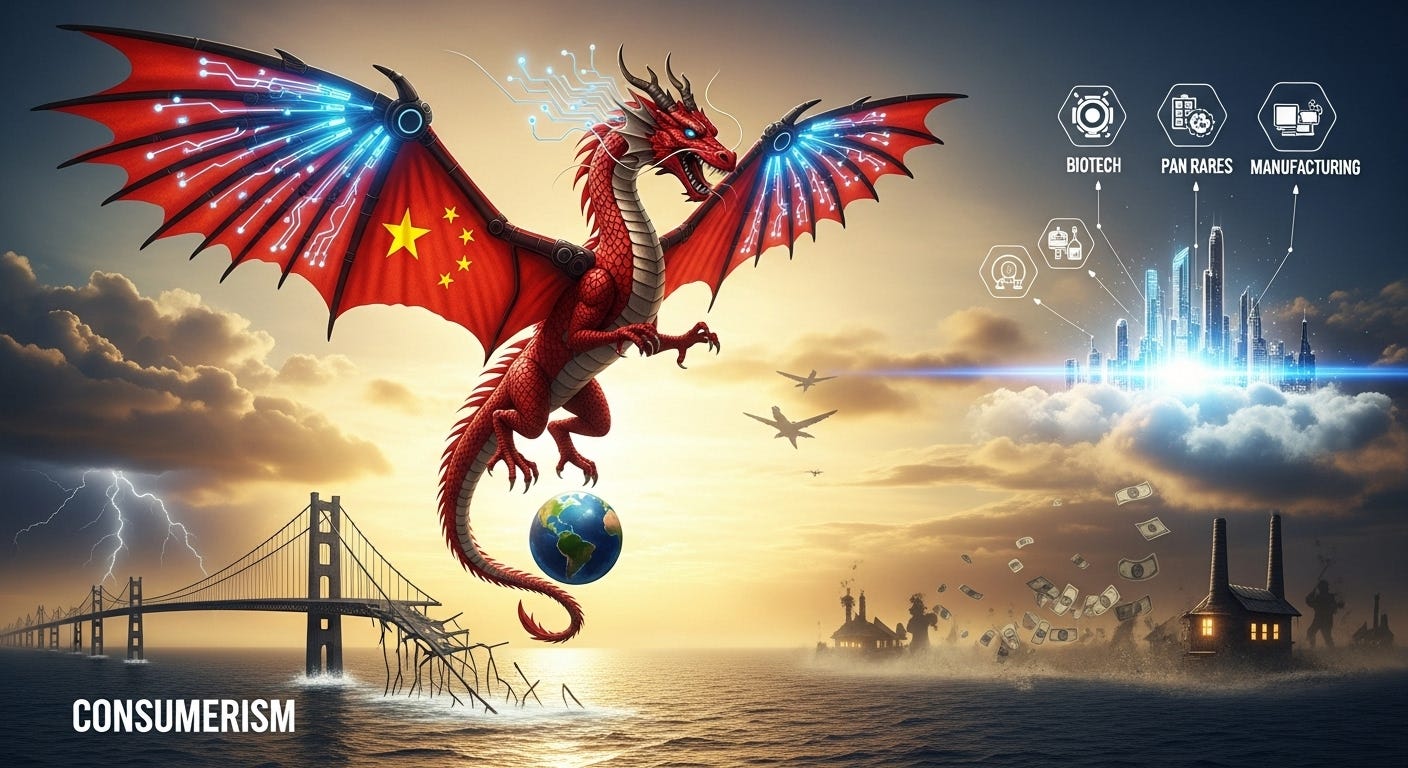
According to the latest news, the Fourth Plenary Session of the 20th CPC Central Committee was held in Beijing. Xi Jinping, General Secretary of the CPC Central Committee and President of the People’s Republic of China, presided over the meeting. In addition to making some personnel appointments and removals, the most important thing at this meeting was the release of the outline of the crucial 15th Five-Year Plan.
The 15th Five-Year Plan focused on outlining China’s strategic decisions regarding high-tech industries such as biotechnology to guide its development over the next five years. Therefore, this five-year plan also signifies China’s ambition to become a developed country.
The Five-Year Plan is a common economic planning method adopted by socialist countries, originating in the Soviet Union. The Soviet Union initiated the world’s first Five-Year Plan in 1928, promoted by General Secretary Stalin, and implemented it through the State Planning Committee.
As a product of a planned economy, the Five-Year Plan has profoundly influenced the Soviet Union and subsequent socialist countries.
Under the guidance of its Five-Year Plans, the Soviet Union rapidly recovered its economy from the Russian Civil War and completed its industrialization in a very short period of time. This was an important guarantee for the Soviet Union’s victory over Nazi Germany in the Great Patriotic War.
After the founding of the People’s Republic of China in 1949, it followed the Soviet Union’s example and launched its first Five-Year Plan in 1953. With the support of subsequent Five-Year Plans, China rapidly recovered its economy from the civil war and completed its industrialization, which is an important foundation for China to become a world manufacturing power today.
The successes of the Soviet Union and China demonstrate that the Five-Year Plan is an effective way to revive a country’s economy and achieve industrialization.
In 1978, China embarked on the path of reform and opening up, thus beginning its initial experiment with a market economy and setting it on a unique path of socialism with Chinese characteristics.
The Communist Party of China drew valuable lessons from the collapse of the Soviet Union, thereby opening a new chapter in the system of socialism with Chinese characteristics and injecting new vitality into China’s economy.
The system of socialism with Chinese characteristics is a unique political and economic system based on reform and opening up, with a market economy at its core, and upholding the leadership of the Communist Party of China.
Under this system, the Five-Year Plan has transformed from a product of the past planned economy into a strategic guiding plan for the overall national economic development.
In other words, China’s Five-Year Plans are no longer guiding documents for a planned economy that dominates everything, but rather strategic guidelines for the overall development of the national economy.
The Five-Year Plans are responsible for setting the overall direction of the national economy for the next five years, while specific economic development is still led by state-owned enterprises, with the market economy at its core, and then completed by private enterprises.
Therefore, the Western media’s denigration of China’s five-year plans as “barbaric relics of a planned economy” is completely untrue and fully exposes the sinister plot of the Western media to smear China.
The 15th Five-Year Plan is a comprehensive development plan for China’s economy over the next five years.

According to the 15th Five-Year Plan, it is not difficult to see the trend of China’s economic development: it is centered on high technology, represented by AI and low-altitude economy, and vigorously develops industries such as biotechnology and biopharmaceuticals, to enable China to lead the new round of globalization in the future and prepare for China to become a developed country and for the Chinese people to live a prosperous life.
China’s development of artificial intelligence and low-altitude economy is not only about winning the technological race with the United States, but more importantly, about creating new economic growth points for China to effectively drive its economic growth.
For a long time, Western economics has dominated the thinking of the world’s economic community. This doctrine has always instilled the view that “consumption drives the economy,” that is, a country’s economic development depends on consumption rather than the improvement of productivity.
This theory of consumption-driven economic development naturally views China, which insisted on developing its manufacturing sector in the 15th Five-Year Plan, as an “outlier.”
The media outlets they dominate, such as CNN, promote the so-called “overcapacity in China,” which is actually an attempt to guide China into a consumerist economic system that has long been proven flawed. Their ultimate goal is to hollow out China’s industries and create favorable conditions for the recovery of American manufacturing.
In fact, whether it was the Industrial Revolution led by the British steam engine, the German electrical revolution, or the information industry revolution initiated by the United States, these trends in global economic development are essentially the most powerful proof of the subsequent economic development following the progress of productivity.
Since the rise of neoliberalism in the West in the 1960s, consumer economics has gradually become the mainstream of Western thought and has begun to poison the thinking of governments and the public. The end result is the long-term deindustrialization of the United States and the West, which has led to the flow of advanced Western industries to developing countries, represented by China.
The core of consumer economics is to encourage consumption, but it avoids a crucial question: where does money come from?
In the minds of these economists, money seems to be printed in printing presses or typed out by banks like the Federal Reserve, ignoring the fact that money is merely a receipt for wealth.
Without wealth, money becomes worthless. So what is wealth? It is the various goods and services created by humankind—this is true human wealth.
This is why China insisted on developing its manufacturing sector in its 15th Five-Year Plan. China clearly understands that wealth can only and must come from the manufacture of real products. This is not about “overcapacity,” but rather something essential for currency issuance. Currency without commodity backing cannot be called currency; it is merely worthless paper. The reason the US dollar can dominate the world is because of its two pillars: oil and Chinese manufacturing.
The world can use US dollars to buy the oil and Chinese-made goods they want. A large part of those so-called high-end luxury goods also comes from China or depends on certain links of Chinese manufacturing. For example, a button on a luxury handbag or a metal badge on a military cap of a certain country. For example, the badge on a British military cap is made in China.
Without Chinese-made dollars, one can only buy crude oil, which currently appears to be primarily paid for in yuan, especially in oil transactions between Russia and India, which are explicitly designated as yuan transactions. This is because Russia can use the yuan to purchase strategic materials urgently needed on the battlefield from China or elsewhere.
Therefore, China’s emphasis on strengthening the development of its manufacturing sector in its 15th Five-Year Plan this year illustrates this point.
This also means that countries like Japan and those in Europe face strong competition from Chinese goods, causing them considerable anxiety.
According to reports, Japanese automakers are facing the risk of bankruptcy due to continued competition from China, while European auto factories, particularly in Germany, have been severely impacted by the Netherlands’ hostile actions towards China, which resulted in a rare earth supply disruption.
These examples have caused great anxiety in Europe and Japan, so they can only rage helplessly in the media and ridicule China in various ways to cover up their inner fear and unease.
In summary, China’s 15th Five-Year Plan is ambitious and visionary. It not only lays the foundation for China’s economic development over the next five years, but also illuminates the path forward for people around the world who have suffered from the trade-trolling tactics of the United States under Trump.
In the future, China will use the BRICS as a stage to strengthen cooperation with countries around the world and compose a great chapter in the building of a community with a shared future for mankind.
Of course, in the face of an increasingly turbulent world, the plan also serves as a warning to the people of the whole country to meet the major test of “high winds and rough seas” and even “stormy waves”. In other words, China has anticipated the major risks of future military conflicts and has made comprehensive combat preparations.
A declining United States is a weak and very dangerous entity. When it is at its wits’ end, it may very well turn to full-scale fascism and then launch wars abroad. Therefore, China also clearly warned the United States through this document that if the United States dares to risk launching a war, China will, in accordance with the will of Heaven and the will of the people, completely crush the conspiracy of American imperialism aimed at undermining world peace.
The New Era has begun!
 | A guest post by
|
A new world is upon. Let's seize the opportunity to create by cooperation and partnership with all nation and China is a great example via BRICS and BRI.
It is clear where China's success in modernisation stems from - 5 year plans researched, debated, implemented and sustained. Here in Australia we basically have a 4 year electoral cycle at federal level. There are only 2 parties that can govern - a socialist left and a coalition of 2 right liberal/rural interest. The electoral margins are often 49/51.They are diametrically opposed in most of their philosophies so as one party comes to power it dismantles the forward programs of the losing party so continuity of programs is a problem for the civil service and a frustration for at least 50% of the electors.