

Between the Hammer and the Anvil: Brazil's Elite Confronts an Old Question in a New Guise
Brazil's elite faces a historical reckoning: trapped between U.S. sanctions and law, and China's growing sway, it must choose. Is dependency fading for an independent path? This brief explores.

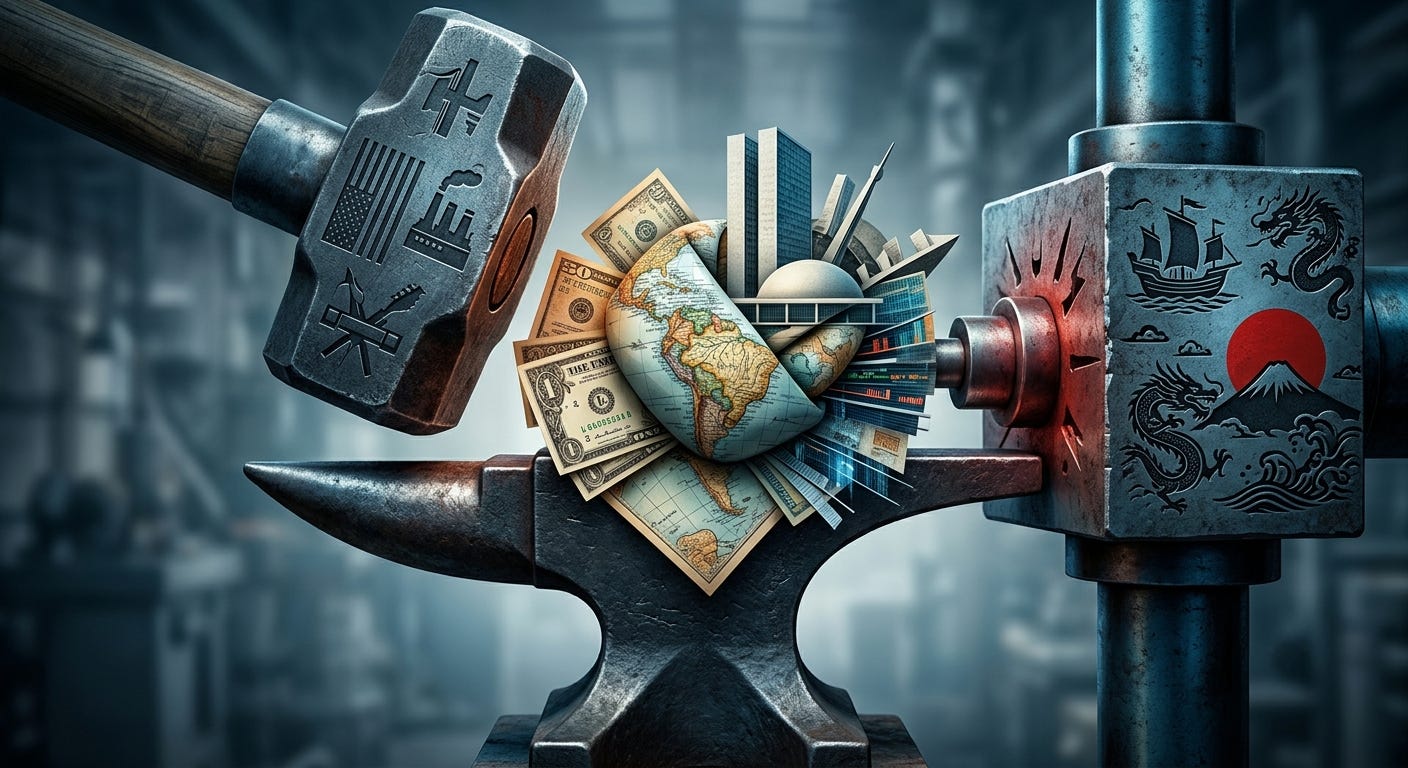
In August 2025, Brazilian banks lost roughly R$41 billion in market value within days — not because of a bad quarter, but because of a legal trap. Washington had sanctioned Supreme Court Justice Alexandre de Moraes under the Global Magnitsky Act. Brazilian Justice Flávio Dino then ruled that any bank complying with the sanction could face punishment under Brazilian law. Financial institutions were left with no safe choice, caught, as Gazeta do Povo reported at the time, between two governments each claiming jurisdiction over the same act.
The consultancy Eurasia Group had a phrase for the predicament, later repeated nightly on CNN Brasil: Brazil’s elite stood “between the hammer and the anvil.” A new brief from the BRICS Policy Center at PUC-Rio, written by researcher Fábio Bussmann, borrows that image and pushes it further — asking not just how Brazil should navigate this particular standoff with Washington, but what the standoff reveals about a five-hundred-year-old bargain now coming apart.
A trade war, or something older?
The economic facts of 2025 are straightforward. Donald Trump imposed a 50% tariff on Brazilian goods and tied it openly to the domestic prosecution of Jair Bolsonaro, which he called a “witch hunt.” By December, Washington had reversed course, lifting the sanctions on Moraes and rolling back most of the tariffs, Reuters reported. Then, in May 2026, the State Department escalated again, moving to designate two of Brazil’s largest criminal factions, the PCC and Comando Vermelho, as Foreign Terrorist Organizations — a decision Secretary of State Marco Rubio linked directly to lobbying from Bolsonaro’s own family, according to Al Jazeera.
Bussmann’s argument is that this whiplash — hostility, thaw, hostility again — can’t be explained by trade figures alone. He draws on dependency theory, the framework built by thinkers like Fernando Henrique Cardoso to describe how peripheral economies stay structurally bound to dominant ones, and adds a dimension classical dependency theory left largely unexamined: race. Brazil’s elite, in his reading, has long tolerated economic subordination to the West in exchange for something harder to price — a promise of partial membership in a Western, and therefore fully “modern,” identity.
The Mongrel Complex
Brazilians have a name for the insecurity that promise produces: complexo de vira-lata, the “mongrel complex,” a phrase the playwright Nelson Rodrigues coined decades ago to describe a national habit of self-deprecation before the developed world. It resurfaced last year when First Lady Janja da Silva invoked it while fielding questions about Trump’s tariffs, and again in November, when German Chancellor Friedrich Merz said his delegation was relieved to leave the COP30 host city of Belém. Lula‘s reply was pointed: Merz, he said, should have gone dancing in a Pará bar, because “Berlin doesn’t offer him 10% of the quality” of the Amazonian state.
Small moments, but Bussmann treats them as symptoms of something larger. What happens to an elite’s sense of self when the bloc it has deferred to for generations increasingly signals — through tariffs, sanctions, and terrorism designations once reserved for adversaries like Venezuela and Iran — that peripheral elites are no longer welcome as junior partners, but regarded as suspects?
Beijing’s different wager
The brief’s counterexample is China, which Bussmann, borrowing from theorist Walter Mignolo, describes as pursuing “de-westernization“ — building legitimacy from Confucian and other domestic intellectual traditions rather than seeking Western approval. Xi Jinping has made the argument explicitly, in speeches from Davos to Communist Party forums, that insisting liberal democracy is a universal template is itself a form of authoritarianism. China has also been Brazil’s largest trading partner since 2009, according to Brasil de Fato, buying more than double what the U.S. does — even as much of Brazil’s elite media continues, culturally, to look toward Washington and Brussels rather than Beijing.
No consensus, just an opening
None of this points to a single direction for Brazil’s political class. Some segments of the elite are drawn to China’s confidence; others, visible nightly on CNN Brasil, still hope for a return to a “normal” West, or are pivoting toward a European Union imagined as a values-based counterweight to both Washington and Beijing.
What the moment offers, in Bussmann’s telling, is something rarer than a policy option: a crack in the promise that has underwritten five centuries of deference — recognition in exchange for loyalty — appearing on the side that made it. Whether Brazil’s elite, and others across the Global South watching the same pattern, treats that crack as a crisis to be managed or a chance to build something independent of Western validation is a question this year’s politics may only partly answer.
Brazil heads into general elections this October with its relationship to Washington still swinging between thaw and confrontation. The more durable question may outlast the vote: what would it take for a nation’s elite to stop asking whether it belongs to the West?
The author’s views are their own and do not necessarily reflect the blog’s.
📌 Subscribe to Think BRICS for weekly geopolitical video analysis beyond Western narratives. Follow also our new channels BRICS Business and Think BRICS Chronicles.
A elite brasileira não tem competência para desenvolver um projeto de pais. Qualquer projeto e qualquer pais.
Competência técnica, competência ética, competência filosófica.
Entendo por elite a burguesia empresarial/financeira, a oligarquia rural multicentenária, os gestores públicos com os maiores salários, a classe média pejotizada.
Esta gente tem conseguido barrar, com sucesso, todo esforço feito pelo povo brasileiro para desenvolver o pais mais rico do mundo. E quando não consegue fazê-lo de forma limpa, apela para golpes, ditaduras e práticas de subserviência explícita com tanta intensidade que causa engulhos a qualquer pessoa que tenha senso crítico e vergonha na cara.
Portanto esqueça a teoria de que nossas elites irão construir um país livre e soberano. Será preciso, antes disso constituirmos uma nova elite. E a gente faz isso com uma revolução que negue todos os princípios que esta elite decadente defende.
This is true of the elites in every colonized region. They were pulled in, educated in USA or Europe, taught the "superiority" of western history (Greek/Roman) & culture, the purity of white skin & blue eyes. They inculcated in every way their lesser being & also enjoyed the wealth, inclusion in western organizations & connection with western leaders & businesses. Thus thoroughly colonized in mind, they cannot support the "mongrel" nation they ostensibly are born from. We see this in Venezuela where the wealthy were glad to see the president kidnapped & the country "overseen" by USA. Colombia has a similar situation, as do many nations in Central & South America. Indonesia, Malaysia, Thailand...so many areas have the same dynamic. Even China was into this until lately, with young people attending USA or European universities. Many 30-40 year olds in China have been educated there.
Economists in Iran studied in USA & only know the neo liberal financialization model they were taught. It is endemic! It all has been reinforced by relentless "Voice of America" narrative for decades, reaching into every aspect of national culture around the world. To de-colonize the mind is of absolute basic necessity everywhere! Chinese awareness is helping to do this gently through trade & interpersonal relations. It will take time & also eventually a firm decision by leaders to help their national internal perception change to self worth & pride. Ibrahim Traore in Burkina Faso is teaching his people this re-orientation away from the internal colonial mindset. This, above all else, is why he is feared by the west.