

A United Front Against Terrorism: BRICS Leaders Convene in Cape Town
BRICS Deputy Foreign Ministers and Special Envoys on MENA: Call for Comprehensive Convention on International Terrorism and Zero-Tolerance Approach.

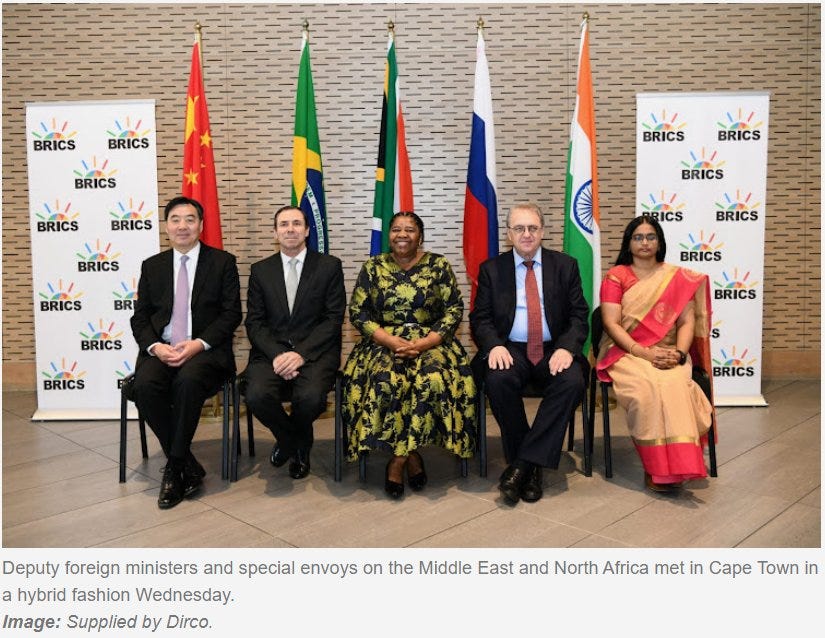
On April 26, the BRICS Deputy Foreign Ministers and Special Envoys on the Middle East and North Africa (MENA) met in Cape Town, South Africa, to discuss pressing issues affecting the region. This collaboration, which consists of Brazil, Russia, India, China, and South Africa, represents 41% of the global population and 24% of the global GDP. The meeting was held in a hybrid format, allowing for both in-person and virtual attendance.
Condemning Terrorism and Extremism: A Zero-Tolerance Approach
During their meeting, the BRICS leaders condemned all forms of terrorism and extremism, including violent extremism that encourages terrorism. They urged countries in the MENA region to adopt a zero-tolerance approach to terrorism and highlighted the crucial role the United Nations must play in coordinating efforts against this global threat.
The leaders agreed that terrorism and extremism should not be associated with any religion, nationality, civilization, or ethnic group. They called for the swift finalization and adoption of a comprehensive convention on international terrorism under the UN umbrella.
Strengthening the UN Security Council Sanctions Committees
In addition to discussing terrorism, the BRICS leaders addressed the need for the consolidation and strengthening of the UN Security Council Sanctions Committees. These committees play a vital role in maintaining international peace and security, and their working methods must be improved to ensure their continued effectiveness.
The Israeli-Palestinian Conflict: A Call for International Efforts
The BRICS leaders expressed deep concern over the deteriorating situation in the Occupied Palestinian territories, resulting from ongoing occupation and the expansion of Israeli settlements. They acknowledged the lack of a permanent solution to the conflict or any foreseeable resumption of negotiations.
The international community must intensify efforts to support a UN-led resolution to achieve a comprehensive, lasting, and just settlement that allows Israel and Palestine to coexist peacefully. This settlement should prioritize the security and stability of both nations.
Sudan's Internal Strife: Urging a Ceasefire and Political Transition
The meeting also addressed the continued clashes between the Sudanese armed forces and the Rapid Support Forces. The BRICS leaders expressed deep concern over the conflict and urged both parties to reach an immediate ceasefire while respecting international and humanitarian law.
They encouraged all parties in Sudan to engage in dialogue to achieve a political transition that meets the country's fundamental interests and the legitimate aspirations of the Sudanese people. The leaders also reiterated their support for joint efforts by the UN, AU, and IGAD to facilitate dialogue between Sudanese parties.
Promoting Peace, Stability, and Development in the MENA Region
The BRICS countries advocated for the strengthening of the multilateral framework of international relations while opposing unilateralism. They emphasized the importance of promoting peace, stability, and development in the MENA region.
Acknowledging the regional situation's impact on global security, stability, and development, the leaders urged the international community to intensify support for development and peace in the MENA region. They called for the alignment of resources and responses to resolve regional conflicts effectively.
Affirming the Primary Role of the UN Security Council
The leaders reaffirmed the primary role of the UN Security Council (UNSC) in maintaining international peace and security. They condemned terrorism and extremism, stressing the importance of the UN's coordination role and opposing double standards.
Addressing Regional Conflicts: Palestine, Syria, Lebanon, Yemen, Iraq, and Western Sahara
The BRICS leaders addressed various regional conflicts and expressed their concerns about the ongoing tensions in Palestine, Syria, Lebanon, Yemen, Iraq, and Western Sahara. They highlighted the need for international cooperation and adherence to UN resolutions to achieve lasting peace and stability in these regions.
Resolving the Palestinian Issue: Direct Negotiations Based on International Law
The BRICS countries emphasized that the question of Palestine must be resolved through direct negotiations based on international law. They called on the international community to work collectively towards a comprehensive and just settlement, ensuring the rights and aspirations of both Israelis and Palestinians are respected.
Supporting a Syrian-Led, Syrian-Owned, UN-Facilitated Political Process
The leaders stressed that the key to solving the Syrian crisis lies in adhering to the principles enshrined in relevant UNSC resolutions. This approach includes facilitating a Syrian-led, Syrian-owned, UN-facilitated political process of reconciliation and inclusiveness, respecting Syria's sovereignty and territorial integrity, and providing international support to address the humanitarian needs of the Syrian people.
Welcoming Rapprochement between Arab Countries and Syria
The BRICS countries welcomed the rapprochement between Arab countries and Syria, as well as steps towards Syrian-Turkish normalization. They expressed their support for efforts conducive to the political resolution of the Syrian crisis, ensuring a future of peace and stability for the nation and its people.
Firm Support for Lebanon's Sovereignty and Territorial Integrity
The leaders emphasized their firm support for Lebanon's efforts to safeguard stability, security, sovereignty, political independence, and territorial integrity. They called for continued international cooperation to address Lebanon's challenges and ensure its future prosperity.
Political Settlement for Yemen and Iraq
The BRICS countries reaffirmed their support for Yemen's sovereignty, independence, and territorial integrity, and called for a political settlement to the ongoing Yemeni crisis. They also reflected on the 20 years since the invasion of Iraq, which has severely affected the country and the wider region. They reiterated their firm support for Iraq's sovereignty, independence, and territorial integrity, and reaffirmed their commitment to assist Iraq in safeguarding national security, stability, and combating terrorism.
Enduring and Mutually Acceptable Political Solution for Western Sahara
Lastly, the leaders emphasized the need to achieve an enduring and mutually acceptable political solution to the question of Western Sahara in accordance with relevant UNSC resolutions. This resolution should respect the rights and aspirations of the people of Western Sahara while promoting regional peace and stability.
Conclusion
The Cape Town meeting of BRICS Deputy Foreign Ministers and Special Envoys on the Middle East and North Africa highlighted the importance of international cooperation and a multilateral approach to addressing the challenges faced by the MENA region. By adopting a zero-tolerance approach to terrorism, strengthening the UN's role in maintaining peace and security, and promoting political dialogue and negotiation to resolve regional conflicts, the BRICS countries are working together to create a more peaceful, stable, and prosperous future for the people of the Middle East and North Africa.