

7 vs. 155: The Irreversible Collapse of Western Hegemony
As the West drives global conflicts into a dangerous new phase, a massive multi-polar realignment is shifting the balance of power. The invisible war for orbital dominance and AI control has begun.


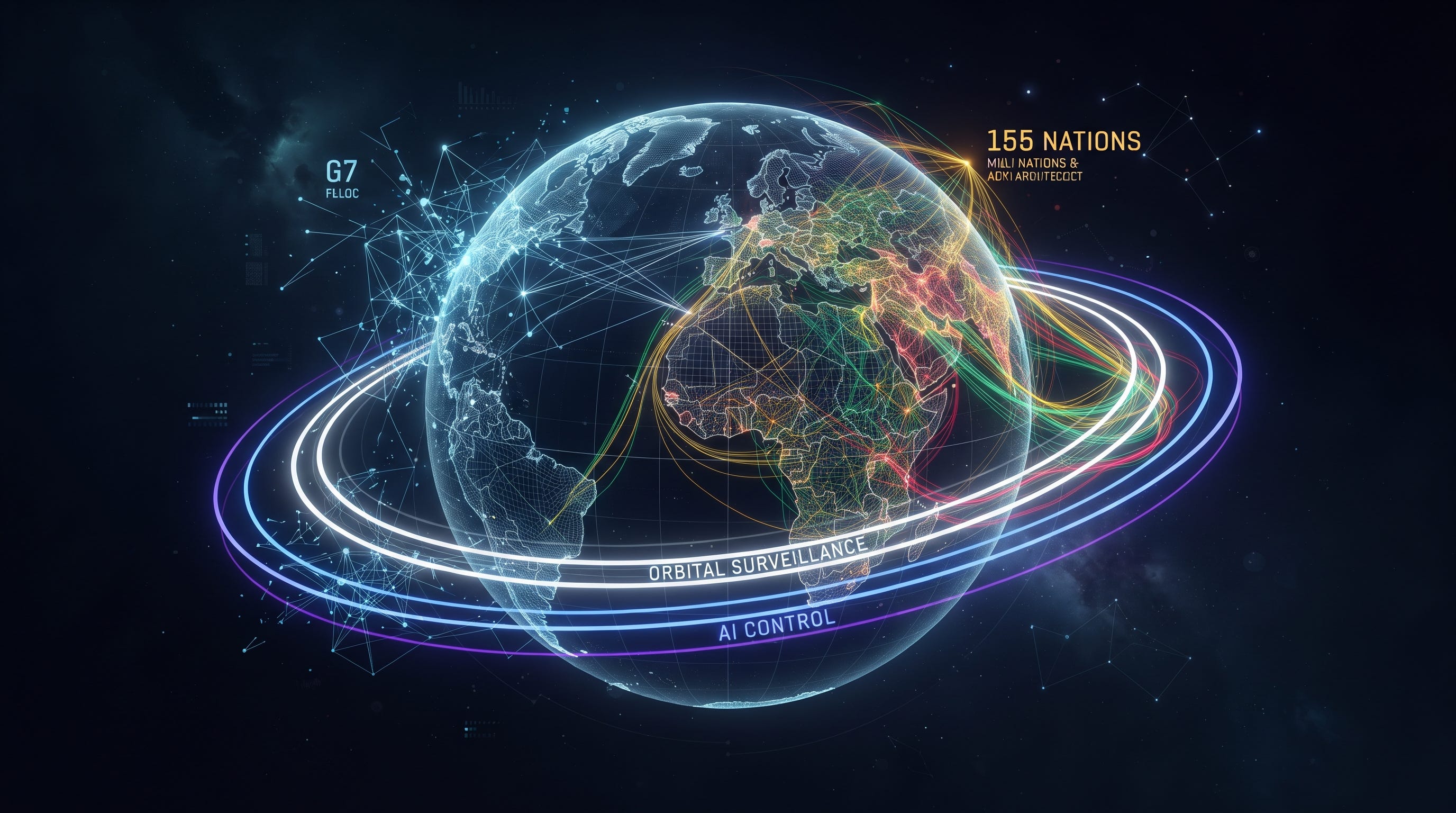
Right now, in the summer of 2026, what was predicted and expected to emerge is beginning to become visible. The transition of global processes to a new level is inevitable. No matter how much money the West pours into propaganda and no matter how much it erases from the news the many strategic strikes and losses it has suffered, the truth is finding its way through, and it is becoming evident that its results point toward decline. This applies to every issue, including artificial intelligence.
The war in Ukraine cannot end because the entire West, along with some of its puppets in the East, has gathered in Novorossiya and is holding the door shut to prevent it from opening. This has become so obvious that only those who are truly blind can deny it. More on Iran in a moment.
As these processes advance, it is becoming clear that Russia, in order to avoid attacking other countries that are attacking it through Ukraine, has entered a new, complex diplomatic, tactical, and strategic phase of decision-making—once again involving choices that are extremely important for the distant future.
I would advise everyone who criticizes Putin—not Russophobes, because they understand nothing about Putin—to consider the complexity of Russia’s position and to inform themselves about just how many global processes Putin manages every single day.
The West continues to do what it has always done: trying to provoke Russia into attacking it so that it can accuse Russia of aggression and evil. Not that it is not making such accusations already, but if Russia were to strike another country because of Ukraine, you would see the face of evil in the West in a form you have never witnessed before—not even in your worst nightmares.
If the West succeeds in provoking Russia into attacking it, even with a single drone strike, let alone missiles, two things will happen. First, the West will unite and become an unbreakable force. Second, it will attempt to strike Russia with nuclear weapons and destroy it completely in order to plunder it. So when you criticize Putin, keep this in mind.
Since such a scenario would inevitably lead to an exchange of nuclear strikes, we would all perish. That is why Putin does not respond in the way many people would like him to. His current strategy is driving the West toward fragmentation, division, and crisis. A direct strike against the West would unite it.
Putin also has other objectives that, unless you study his work, you would never even suspect. One of his many goals is to RESTORE RUSSIA’S RELATIONS WITH EUROPE. People may consider him crazy or foolish—it makes no difference. I believe this is one of the most appropriate strategies and probably the only genuinely viable winning strategy.
As long as the West continues to provide Ukraine with money and weapons, the war will not end. Yes, Russia may eventually be left with nothing but bread to eat, but it will not back down. If Putin is removed from power, we return to the scenario described above, which will ultimately prove destructive for the West itself.
What can the West do? The only thing it can do is what it has been doing all along: wage endless war. It is becoming increasingly obvious that the West can maintain its hegemony, as well as its façade of non-existent freedom and democracy, only through perpetual war.
But perpetual war requires two things: constant money printing and a constant supply of proxies around the world willing to serve as proxies—in other words, cannon fodder. Neither is particularly difficult to obtain.
This brings us to Iran, which has resisted and will continue to resist the West. If the West intensifies its war against Iran, the East will do exactly what the West has done in Ukraine: supply Iran with money and weapons and draw the West into a prolonged conflict.
At this point in my analysis, someone might say: “Let’s compare the strength of both sides.”
The West consists of the EU and NATO—that is, Europe, the United States, Canada, the United Kingdom, Australia, and Japan. The G7.
The East consists of BRICS, the Shanghai Cooperation Organisation (SCO), ASEAN, Africa, and all of Latin America.
The overall picture clearly suggests that seven countries cannot dominate 155 countries around the world. However, that is precisely the issue. The West turns other countries into its donors and controls them in such a way that, although they are not part of the G7, they sustain the G7 and exist to feed it. Bulgaria, for example.
That is how Western dominance functions. This, too, is changing. I can already identify at least four regions of the world where the conditions exist for rejecting Western dominance: Latin America, North Africa, Eastern Europe, and the Middle East. The process is slow and difficult, but irreversible.
The new phase of the war involving Iran has been marked by the participation of a Chinese satellite system for precision strikes. There are probably Russian systems involved as well, but the Chinese one is more competitive than the American counterpart.
This is also the moment to point out that Ukraine began striking Russia with drones after Palantir became involved. Consequently, Putin is now also fighting Palantir.
Chinese satellite targeting in Iran means that the struggle for control of Earth’s orbit has begun, as has the struggle in the field of artificial intelligence—a field for which Russia and China have been preparing for years. Once again, I will say that Putin has been working on this issue for ten years, while China has been preparing for even longer.
Europe is effectively blind when it comes to orbital surveillance, relying entirely on American capabilities. This means that without the United States and without Russia, Europe is a corpse. Alongside energy, this is yet another area in which it is helpless.
Against the backdrop of the new escalation in the Middle East, initiated directly by the American president, comes another move: an entirely fabricated accusation that China interfered in U.S. elections. In other words, Trump is openly declaring war on China—first on the Iranian front and second on the front of hybrid warfare.
Here is the picture: the United States is waging war against Russia, against Iran, and against China.
Why? Because if it were not fighting these wars, it would have to admit that it has become a third-rate power, discuss its multi-trillion-dollar debt, acknowledge that it is a colony of Israel, and admit its inability to control the world.
Hence: perpetual war.
In the field of artificial intelligence, something extraordinary is happening. There is no doubt that humanity will move its way of life onto the rails of AI; that is inevitable. The question is who uses it, for what purposes, and how.
For the first time, the United States has placed a resource under exceptional state control, and that resource is AI. I have predicted that this will eventually lead to a struggle—even a war—between the White House and the major technology corporations.
Control over AI must become global and international, just as control over nuclear weapons has, otherwise an apocalypse comparable to nuclear catastrophe will arrive—only slower and more painful.
A struggle over AI, or a war between states using AI, would mean the end of civilization on this planet. This scenario has long been envisioned and described in books, novels, and thrillers that are shifting from science fiction into reality.
Just as with nuclear weapons, the United States has only two genuine allies on the issue of AI: Russia and China.
Iran’s precision strikes have begun to inflict serious damage on the United States. Dead American soldiers, as well as destroyed bases, aircraft, and helicopters, are not good news for Washington.
In other words, the Iranians—portrayed as savages by Western propaganda, which depicts only itself as civilized while labeling everyone else as “vatniks,” savages, orcs, and terrorists—are beginning to challenge the U.S. presence in the region.
Here again, the proposed solution becomes... a nuclear strike against Iran. We will likely see more reports about such intentions.
A nuclear strike against Iran would almost certainly trigger a Chinese nuclear strike somewhere in the Middle East. That is not a simple matter. Not to mention that Iran itself may be capable of producing such a weapon.
Perpetual war is entering a new phase—one that is even more dangerous to global security and creates an even greater need, in the author’s view, to restrain and limit the West for the good of everyone.
The author’s views are their own and do not necessarily reflect the blog’s.
📌 Subscribe to Think BRICS for weekly geopolitical video analysis beyond Western narratives. Follow also our new channels BRICS Business and Think BRICS Chronicles.
 | A guest post by
|
Will western leaders ever come to their senses? It's time for them to take a few deep breaths and look for other options besides war. Peace and a Green New Deal would be my vote, and a good dash of diplomacy too.
When a dog looks in the mirror it sees another dog, when America looks in the mirror it sees 🇮🇷